



Odisha Police Station CCTV Paradox: 16,672 Cameras, Yet 828 Offline as ₹76 Crore Returns
Key Points
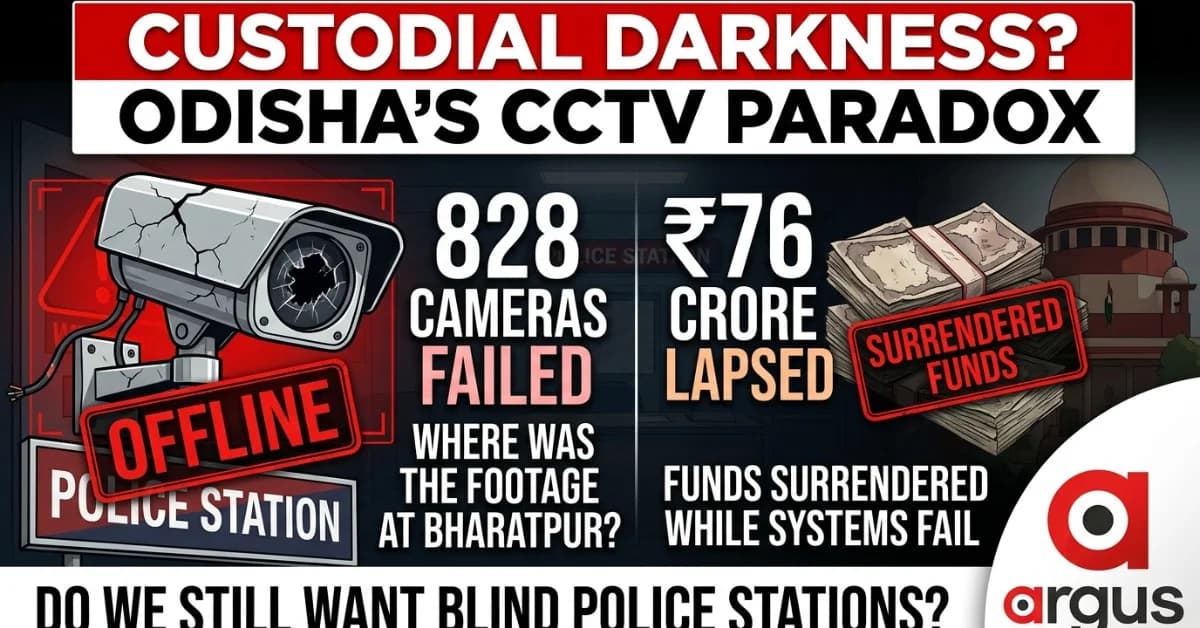
Critical Downtime: A diagnostic report reveals that 828 CCTV cameras (roughly 5% of Odisha's 16,672-camera police network) are currently offline.
The Funding Paradox: The crisis deepened after a ₹76-crore budget allocation meant for the surveillance project was allowed to be surrendered.
Accountability Gap: Disconnections between local stations, OCAC, and vendors have trapped the system in bureaucratic loops rather than ensuring continuous oversight.
Bhubaneswar: Odisha has spent years building a statewide police surveillance network in response to one of the Supreme Court’s most consequential directions on custodial transparency.
But six years after the landmark Paramvir Singh Saini vs Baljit Singh judgment, the state now faces an uncomfortable paradox: the cameras may have been installed, but the system designed to ensure that they remain functional has not worked with the same consistency.
As of September 17, 2026, 828 CCTV cameras – 795 in police stations and 33 in outposts – were reported non-functional, according to the latest diagnostic report generated by Krystal Integrated Services and cited by the Odisha Police. At the same time, the police have sought restoration of Rs 76 crore that had been surrendered under the CCTV surveillance project for 2025-26.
That makes the present controversy more than a maintenance problem. It exposes a systemic flip-flop: install first, monitor later, identify failures after they accumulate, seek funds after the budget cycle has passed, and then attempt to restore a system whose uninterrupted functioning was supposed to be guaranteed in the first place.

📱 Get Argus News App
✨The Bharatpur question: what happens when the camera is missing when it matters?
The significance of the failure cannot be separated from the September 2024 Bharatpur police station episode, when allegations of custodial abuse brought the issue of police-station surveillance into sharp public and judicial focus.
The importance of CCTV in such circumstances is not merely investigative. The Supreme Court conceived police-station cameras as a transparency and accountability mechanism capable of creating an objective record of what happens inside spaces controlled by law-enforcement agencies.
That principle was explicit in Paramvir Singh Saini. In its December 2, 2020 judgment, the Supreme Court directed every State and Union Territory to ensure CCTV coverage of every police station, including entry and exit points, lock-ups, corridors, reception areas, interrogation-related areas and other specified locations. The Court also required night vision and both audio and video recording, with footage to be preserved for 18 months, subject to the equipment availability qualification laid down in the judgment.
The Bharatpur episode therefore exposed the most fundamental weakness possible in such a system: when an incident occurs, the value of a CCTV network depends not on how many cameras were sanctioned or installed, but on whether the relevant camera was actually working and whether its footage was available.
Six years later, the problem is no longer installation
Odisha's numbers demonstrate the scale of the infrastructure created after the Supreme Court's intervention.
The state now has 16,672 CCTV cameras covering 645 police stations and 263 outposts. The 828 cameras presently reported offline therefore represent roughly 5% of the installed network.
Odisha CCTV network at a glance
|
Indicator |
Present position |
|---|---|
|
CCTV cameras installed |
16,672 |
|
Police stations covered |
645 |
|
Police outposts covered |
263 |
|
Cameras offline |
828 |
|
Offline at police stations |
795 |
|
Offline at outposts |
33 |
|
Offline share of installed network |
~4.97% |
|
Funds surrendered |
₹76 crore |
The percentage can make the problem appear relatively small. But a CCTV network cannot be assessed like an ordinary infrastructure project where 95% functionality might be considered satisfactory.
One non-functional camera can mean zero evidence for one location at one critical moment.
That is precisely why the Supreme Court's framework is centred on functionality, coverage and preservation rather than merely physical installation.
From 392 to 518 to 828: the warning signs kept multiplying
The present figure also did not emerge overnight.
According to the available reports, 392 of 821 cameras across 41 critical police stations were found defunct by February 2026. By April, the reported number had risen to more than 518. At the same time, another structural weakness emerged: 249 police stations had not connected their local Video Management Systems with the Central Monitoring System at police headquarters.
The latest diagnostic exercise has now identified 828 cameras offline.
The progression matters because it suggests that the problem was visible before the latest crisis.
The issue, therefore, is not simply whether the state knew that cameras were failing. The more important administrative question is what happened between detection of failure and restoration of functionality.
The ₹76-crore paradox
This is where the story moves from technology to governance.
The Odisha Police has now sought restoration of Rs76 crore after the amount allocated for the CCTV surveillance system in 2025-26 was surrendered. The police communication has requested directions to OCAC for immediate restoration of the non-functional cameras and continuous functioning of the network.
This creates the central paradox:
The state has a legally mandated surveillance system, has identified defective equipment, has an identified technical implementation mechanism, and has a stated requirement for maintenance funding – yet the money required to keep the system operational was allowed to lapse or be surrendered.
The immediate remedy is now another funding exercise.
That is precisely the kind of administrative loop that undermines a rights-protection mechanism.
OCAC, Police and the vendors: responsibility split, accountability blurred
The architecture of the project also helps explain how the problem can persist without any single component appearing to own the entire failure.
Odisha Police is the operational stakeholder. It needs functional surveillance at police stations and outposts and is exposed to the consequences when footage is unavailable.
OCAC, as the state's IT nodal agency for the project, sits closer to the contractual and financial chain.
KELTRON and Krystal Integrated Services operate at the technical execution level, including installation, troubleshooting and system diagnostics.
The latest report itself is significant because it is the technical system integrator that has identified the 828-camera failure.
But technical identification is not the same as technical restoration.
The resulting chain can become circular:
Police identifies operational failure → technical agency diagnoses it → funding/contractual approval is required → funding is delayed or surrendered → replacement and field restoration slow down → the number of failed cameras rises → another audit identifies the problem.
The problem, therefore, is less about one failed camera than about the absence of a sufficiently automatic institutional mechanism that converts a detected failure into immediate restoration.
Supreme Court's warning has become particularly relevant
The Supreme Court itself has recognised that CCTV compliance cannot be reduced to paperwork.
In April 2023, while dealing with the Paramvir Singh Saini proceedings, the Court observed that the litigation was not adversarial and that States and Union Territories were expected to comply with the directions intended to maintain transparency in police stations.
More importantly, the Court has since opened a separate suo motu proceeding – "In Re: Lack of Functional CCTVs in Police Stations" – after continuing concerns over non-functional surveillance systems across the country. In January 2026, the Court was considering mechanisms including centralised dashboards, standardisation of CCTV infrastructure, storage mechanisms, audit protocols and independent oversight.
That is an important evolution.
The judicial concern has moved beyond "Have you installed CCTV cameras?" to the much more consequential question: "Do the cameras actually function, and can the system prove that they function?"
Odisha's current situation falls squarely into that second category.
The systemic flip-flop
The Odisha experience reveals at least four distinct gaps.
|
Supreme Court objective |
Ground-level administrative problem |
|---|---|
|
CCTV in every police station |
Large network physically installed |
|
Continuous functionality |
828 cameras currently offline |
|
Recording and preservation |
Functionality itself has become a recurring issue |
|
Institutional monitoring |
249 stations reportedly lacked VMS-to-central monitoring integration |
|
Sustainable compliance |
₹76 crore maintenance-related allocation was surrendered |
|
Accountability |
Multiple agencies divide technical, financial and operational responsibilities |
This is why describing the issue merely as "828 cameras not working" understates the problem.
The bigger failure is the disconnect between compliance on paper and compliance in operation.
A government can report thousands of cameras installed. A contractor can complete deployment. A police station can possess CCTV hardware. A department can produce compliance documents.
But when an incident occurs and the relevant camera is dead, the constitutional purpose behind the entire exercise is defeated at the point where it matters most.
Where the Gap?
Government funds are released in strict, milestone-based tranches. For OCAC to release the next chunk of the Rs76 crore, KELTRON had to prove certain uptime metrics. However, because 249 stations were completely unlinked from the Central Monitoring System, there was no automated way to verify that uptime.
Instead of sitting down to resolve the network integration issue, the agencies got stuck in a loop of letter-writing: the Police blamed the network, OCAC blamed the vendors, and the vendors blamed the lack of payments.
Bharatpur should have been the turning point. The present data suggests otherwise.
The 2024 Bharatpur episode should logically have transformed CCTV maintenance from an ordinary technology-contract issue into a core police accountability function.
Instead, the subsequent sequence – rising numbers of non-functional cameras, disconnected video management systems, repeated technical diagnosis and finally the surrender of Rs76 crore followed by a fresh request for funds – suggests that the system continued to treat surveillance infrastructure partly as a project to be installed, rather than as a rights-protection system that must operate continuously.
That distinction is crucial.
The Supreme Court's 2020 framework was never simply about putting cameras on walls. It was about creating an evidentiary trail inside institutions where citizens are most vulnerable to abuse of authority. The Court's subsequent proceedings on non-functional CCTVs underline that installation alone does not satisfy that objective.
Odisha now has the hardware.
What the latest 828-camera figure and the Rs76-crore surrender expose is the missing layer: a fail-safe administrative system that treats CCTV downtime as an immediate accountability event rather than a procurement or budget-cycle problem.
And
that is the real lesson from Bharatpur.
Also Read: EXCLUSIVE| Ganjam Police Bust Illegal Gunmaking Unit In Bhanjanagar, What Big New Trend it Signals to Odisha Police?