



Myth of ‘Dropped Charges’ in Pitabas Murder: What Berhampur police Final Chargesheet Means for Bikram Panda, Shiva Shankar Das| Special Report
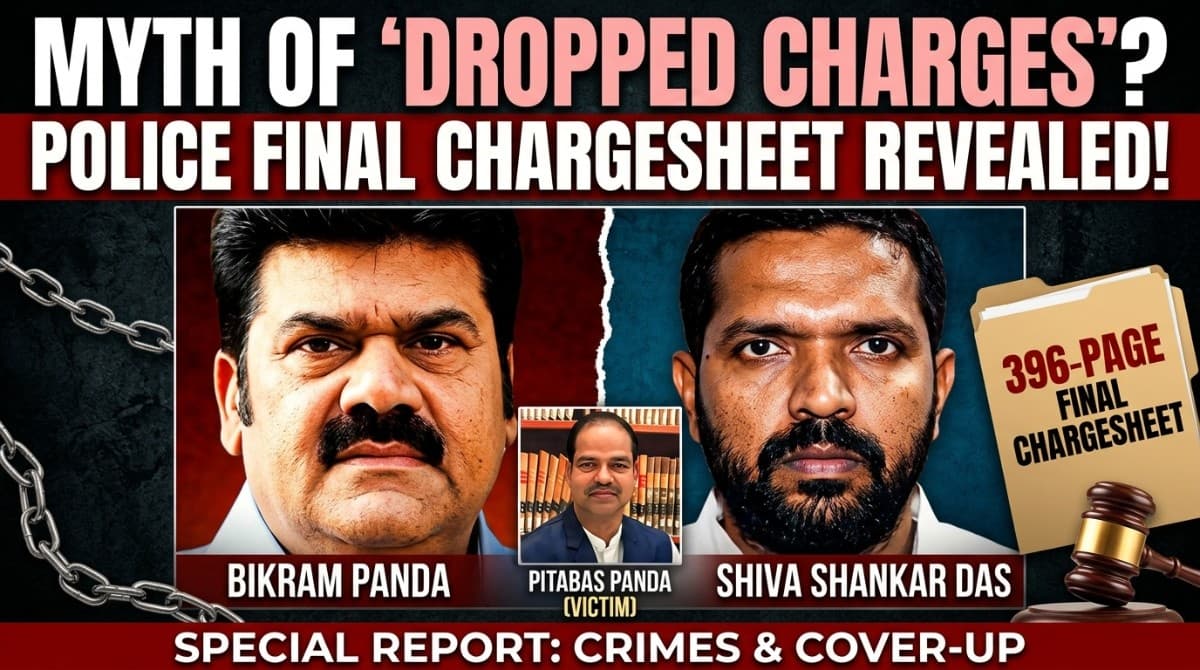
Key Points
Strategic Restructuring: Direct murder charges were kept only for the shooters to eliminate defense loopholes regarding physical absence from the crime scene.
The Conspiracy Backbone: The 396-page final chargesheet heavily relies on digital evidence and two crucial eyewitnesses who allege a political planning meeting in 2025.
Equal Punishment Potential: Under Indian law, proving criminal conspiracy (IPC 120B/BNS 61) carries the exact same weight as the execution, exposing masterminds to life imprisonment.
Bhubaneswar: Headlines declaring that Berhampur Police have "dropped murder charges" against key political leaders in the sensational murder of senior advocate, RTI activist and BJP supporter Pitabas Panda have triggered widespread speculation that the case against the accused has weakened.
However, a close reading of the 396-page final chargesheet suggests precisely the opposite.
Far from diluting the prosecution, it seems the police appear to have strategically restructured the case to eliminate potential defence loopholes while shifting the trial's focus squarely onto criminal conspiracy, organized crime and post-crime cover-up – areas where Indian criminal jurisprudence often treats masterminds and executioners alike.
From Blanket Murder Charges to Role-Specific Liability

📱 Get Argus News App
✨The supplementary chargesheet, filed after the earlier 1,660-page preliminary chargesheet submitted in January, names 16 accused, including several prominent BJD leaders:
- Former Berhampur MLA and BJD Ganjam district president Bikram Panda
- Former Berhampur Mayor Shiva Shankar Das alias Pintu Das
- BJD corporator Malay Bisoi
- BJD leader Madan Dalei
- Sunya Chandra Das
The biggest talking point has been that direct murder charges have now been retained only against the alleged shooters and the person who transported them, while 14 others – including the political heavyweights – are no longer booked for the physical act of murder.
But that distinction is rooted in a fundamental principle of Indian criminal law.
Physical Execution Is Different From Criminal Responsibility
Under Indian law, investigators must distinguish between:
- the overt act of committing murder, and
- the criminal liability of those who allegedly conceived, financed, directed or protected the crime.
Only the men who allegedly fired the fatal shots – and those directly involved in executing the attack – can ordinarily face charges based on the physical act of murder.
The alleged planners were nowhere near the crime scene.
That does not absolve them.
Instead, Berhampur Police have shifted the prosecution towards offences carrying independent and equally serious consequences.
“The Brain Can Be As Guilty As the Hand”
The prosecution has retained the most significant provisions:
- Criminal Conspiracy (IPC Section 120B/BNS Section 61)
- Organized Crime (BNS Section 111)
- Destruction of Evidence (IPC Section 201/BNS Section 238)
- Harbouring Offenders (IPC Section 212/BNS Section 249)
- Arms Act provisions relating to procurement and facilitation of illegal firearms.
The legal philosophy is straightforward.
Under Indian criminal jurisprudence, once a conspiracy to commit murder is established, every conspirator becomes legally responsible for the crime committed in furtherance of that conspiracy.
In effect, if investigators prove the alleged planning meeting and the common intention behind it, the shooters merely become the physical instruments of a jointly conceived crime.
Why Police May Have Strengthened the Case
Legal precedents suggest the revised chargesheet appears designed to avoid one of the strongest defence arguments available in politically sensitive murder trials.
Had prosecutors continued to insist that political leaders committed murder despite being nowhere near the crime scene, defence lawyers could repeatedly point to:
- absence from the scene,
- lack of weapon recovery,
- no physical participation,
- no eyewitness placing them at the shooting.
The revised chargesheet removes that battlefield altogether.
Instead, prosecutors now need to establish:
- the conspiracy,
- the meeting of minds,
- financial and logistical support,
- destruction of evidence,
- organized criminal backing.
Those issues are often proved through witness testimony, digital evidence and circumstantial links rather than physical presence.
2 Eyewitnesses Become Backbone of the Case
The entire prosecution appears to revolve around two crucial eyewitnesses.
According to the final chargesheet, both witnesses described an alleged meeting during the Gosani Nuagaon Kalua Jatra in 2025.
Their statements reportedly establish:
- the presence of several political leaders,
- discussions regarding eliminating Pitabas Panda,
- planning the execution around Kumar Purnima,
- arrangements for helping shooters escape Odisha,
- instructions to erase WhatsApp communication after the killing.
Investigators believe this meeting transformed what initially appeared to be an isolated murder into an organized criminal conspiracy.
Although the verbatim statements remain sealed court records, the prosecution has relied heavily on their substance while filing the final chargesheet.
Digital Evidence Plays a Central Role
Police have also built the prosecution around allegations that communication trails were systematically erased after the killing.
The chargesheet alleges:
- deletion of WhatsApp histories,
- destruction of digital footprints,
- coordinated efforts to help accused flee the State,
- concealment of the conspiracy through electronic evidence tampering.
These allegations form the basis of independent criminal offences irrespective of whether someone fired the fatal shot.
Organized Crime Angle Raises Stakes
Perhaps the most significant legal shift is invocation of organized crime provisions.
By invoking BNS Section 111, investigators are attempting to portray the murder not as a spontaneous political clash but as a structured criminal operation allegedly backed by influence, financial support and coordinated planning.
That substantially changes the complexion of the prosecution.
Instead of trying to prove who pulled the trigger alone, the trial may now focus on whether an organized network commissioned and facilitated the killing.
Indian Courts Have Seen This Before
The legal strategy is not unprecedented.
A striking parallel exists in the Supreme Court's judgment in Bilal Hajar v. State (2018).
There too:
- conspirators allegedly met days before the murder,
- separate hitmen executed the killing,
- the mastermind was absent from the crime scene,
- the prosecution charged the shooters for murder while prosecuting the planner primarily under criminal conspiracy.
The defence argued that the mastermind could not be punished like the killers because he never wielded a weapon.
The Supreme Court rejected that contention.
The Court held that once criminal conspiracy is established, every conspirator becomes a partner in the offence.
The physical act of the shooter is legally treated as the act of all conspirators acting pursuant to the common design.
The result was striking.
The mastermind and the executioners ultimately faced the same punishment –life imprisonment.
Why "Dropped Murder Charge" Narrative Can Be Misleading
When much of the focus has centred on one headline:
"Murder charges dropped against political leaders."
Legally, however, that tells only half the story.
The prosecution has not removed allegations that these accused planned, financed, facilitated or concealed the murder.
Instead, it has reclassified their criminal liability according to their alleged role.
If the conspiracy is ultimately proved, Section 120B of the IPC (now reflected in Section 61 of the Bharatiya Nyaya Sanhita) provides that a person who joins a conspiracy to commit an offence punishable with death or life imprisonment can be punished in the same manner as if he had abetted that offence.
In practical terms, conviction for conspiracy to commit murder can still expose an accused to life imprisonment.
Trial Now Moves to the Conspiracy
The prosecution has already submitted digital evidence through a pen drive along with the final chargesheet.
The next hearing is scheduled for July 4, 2026.
Rather than debating who fired the gun, the courtroom battle is now expected to revolve around far more complex questions:
- Was there a conspiracy?
- Did the alleged Kalua Jatra meeting actually occur?
- Are the two eyewitnesses credible?
- Can digital evidence establish coordinated planning?
- Was there a deliberate effort to destroy forensic evidence and shield the assailants?
The answers
to those questions – not the absence of political leaders at the crime scene – may
ultimately determine the fate of one of Odisha's most closely watched murder
trials.
Also Read: Murder Mystery / Conspiracy! Police Recover CCTV Footage in Pitabash Panda Murder Case
Related Topics
Explore more stories