



GRP Constable Soumya Swain Lynching: Crime Branch Chargesheet Exposes Probe Gaps, Sets Stage for BNSS-Era Test of Evidence| Special Report
Key Points
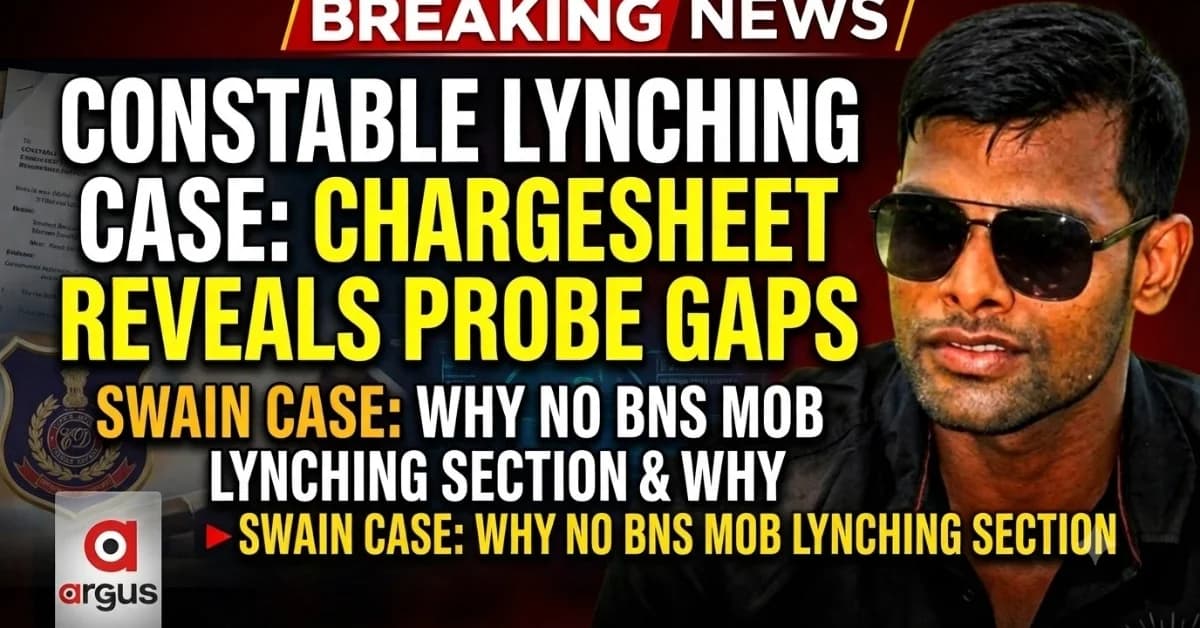
Bhubaneswar: The Crime Branch chargesheet in the high-profile mob lynching of Government Railway Police (GRP) constable Soumya Ranjan Swain has moved the case from the realm of public speculation to a legally defined prosecution. But beyond naming 11 accused, the chargesheet also lays bare the investigative limitations that will shape the trial under the Bharatiya Nagarik Suraksha Sanhita (BNSS).
An analysis of the 767-page chargesheet, read alongside the provisions of the BNSS and the Bharatiya Nyaya Sanhita (BNS), shows that the prosecution now faces a fundamentally evidence-driven battle. The document records several unresolved aspects of the investigation, forcing the Crime Branch to invoke the BNSS provision permitting further investigation even after filing the primary chargesheet.
Chargesheet Changes the Narrative
One of the most significant findings in the chargesheet is the dismantling of an early narrative surrounding the incident.

📱 Get Argus News App
✨The investigation concludes that the deceased constable had no prior acquaintance with the woman involved in the episode preceding the assault. This removes the possibility of an earlier personal connection forming the basis of the violence.
Instead, the chargesheet portrays the incident as one triggered by an immediate sequence of events that escalated into mob violence rather than a pre-planned attack.
The investigation also records that the constable had consumed drugs in substantial quantity and was under severe emotional distress before the incident. These findings form part of the prosecution's reconstruction of the events leading to the assault.
Why the Case Was Not Booked Under BNS Mob Lynching Provision
Although popularly described as a lynching case, the Crime Branch has not invoked the specific mob lynching provision under Section 103(2) of the Bharatiya Nyaya Sanhita.
Instead, it has proceeded under Section 103(1) dealing with murder, read with provisions relating to unlawful assembly and common object under Sections 189 and 190 of the BNS.
The distinction is legally significant.
Section 103(2) applies when a murder is committed by a mob on grounds such as race, caste, community, sex, place of birth, language or personal belief.
The chargesheet, however, records the violence as arising from a sudden confrontation rather than any protected identity-based motive. Consequently, investigators have relied on the doctrine of unlawful assembly and common object instead of the specific mob lynching clause.
Common Object, Not Prior Conspiracy
The prosecution case also reflects the legal framework applicable to spontaneous mob violence.
Unlike a conventional murder investigation where police attempt to establish planning, motive, conspiracy and preparation, this prosecution rests on proving that members of the unlawful assembly developed a common object during the incident itself.
Under the BNS, prior planning is not an essential ingredient if investigators can establish that individuals actively joined the assault while sharing the common object of the unlawful assembly.
That changes the evidentiary burden before the court.
Instead of proving conspiracy, investigators must demonstrate each accused's participation through objective evidence such as videos, digital records and eyewitness accounts.
Chargesheet Reveals Investigation Gaps
The chargesheet itself highlights several areas where the investigation remains incomplete.
Nine Suspects Kept Outside Primary Chargesheet
Perhaps the biggest revelation is that although 20 persons were examined during investigation, only 11 have been chargesheeted.
The remaining nine have not been prosecuted at this stage because investigators stated that evidence of their active participation was insufficient.
This illustrates the central challenge in spontaneous mob crimes – mere presence at the scene does not automatically establish criminal liability. The prosecution has to distinguish between spectators and participants using legally admissible evidence.
Probe Into Drug Source Remains Unanswered
While the chargesheet records heavy drug consumption by the deceased constable, it does not establish how the prohibited substances were procured.
The omission leaves a separate investigative question unanswered regarding the possible drug supply chain connected to the incident.
Pending Forensic Reports
The Crime Branch has acknowledged that certain forensic examinations are still awaited.
These include scientific reports that are intended to supplement the existing evidence already collected.
As a result, the investigation has not been closed despite submission of the primary chargesheet.
Some Suspects Yet to Be Arrested
The chargesheet also indicates that not all identified suspects have been apprehended.
Consequently, parts of the factual sequence remain under investigation.
BNSS Section 193(9): Why the Investigation Continues
The Crime Branch has invoked Section 193(9) of the Bharatiya Nagarik Suraksha Sanhita, the provision governing further investigation after filing of a police report.
The section replaces the earlier Section 173(8) of the Code of Criminal Procedure but introduces greater procedural oversight.
The provision enables investigators to continue collecting evidence after filing the initial chargesheet and submit supplementary reports before the trial court.
For this case, it serves multiple procedural purposes:
- It allows investigators to continue probing the remaining nine suspects without delaying commencement of proceedings against the 11 already chargesheeted.
- It permits incorporation of pending forensic reports and digital evidence through supplementary chargesheets.
- Once the trial commences, any further investigation requires permission of the trial court, introducing judicial supervision over subsequent probe.
- The supplementary investigation is also expected to proceed within the statutory framework prescribed under the BNSS, with any further extension requiring judicial satisfaction.
Digital Evidence Now Becomes Central
The chargesheet indicates that the prosecution has built its case around scientific material rather than only oral testimony.
Its 767 pages include post-mortem findings, chemical examination reports relating to drugs and the polygraph examination of a key accused, apart from digital material.
Given the absence of allegations of prior conspiracy, the prosecution's success is likely to depend on whether electronic evidence can individually attribute acts of violence to each accused.
The defence, in turn, is expected to test whether every person identified was an active participant or merely present in a rapidly evolving crowd.
BNSS-Era Trial Focuses on Individual Culpability
The Soumya Ranjan Swain case also illustrates how the BNSS framework seeks to balance continuity of investigation with progression of trial.
Instead of waiting indefinitely for every forensic report and every suspect to be traced, the law allows prosecution to begin on the strength of available evidence while permitting legally supervised supplementary investigation.
At the same time, the chargesheet itself underscores the practical challenges of prosecuting spontaneous mob violence. Without evidence of prior planning, the burden shifts almost entirely to scientifically establishing the precise role played by each accused.
As the case enters the judicial phase, the outcome is likely to depend less on the existence of a violent crowd and more on whether the prosecution can legally prove the individual acts of each accused through digital and forensic evidence within the procedural safeguards laid down by the BNSS.Related Topics
Explore more stories