



Fake IAS, Fake DSP, Fake PA to Mins: How in Odisha Known History-Sheeters Become ‘New’ Conmen Ducking Police Radar| Special Report
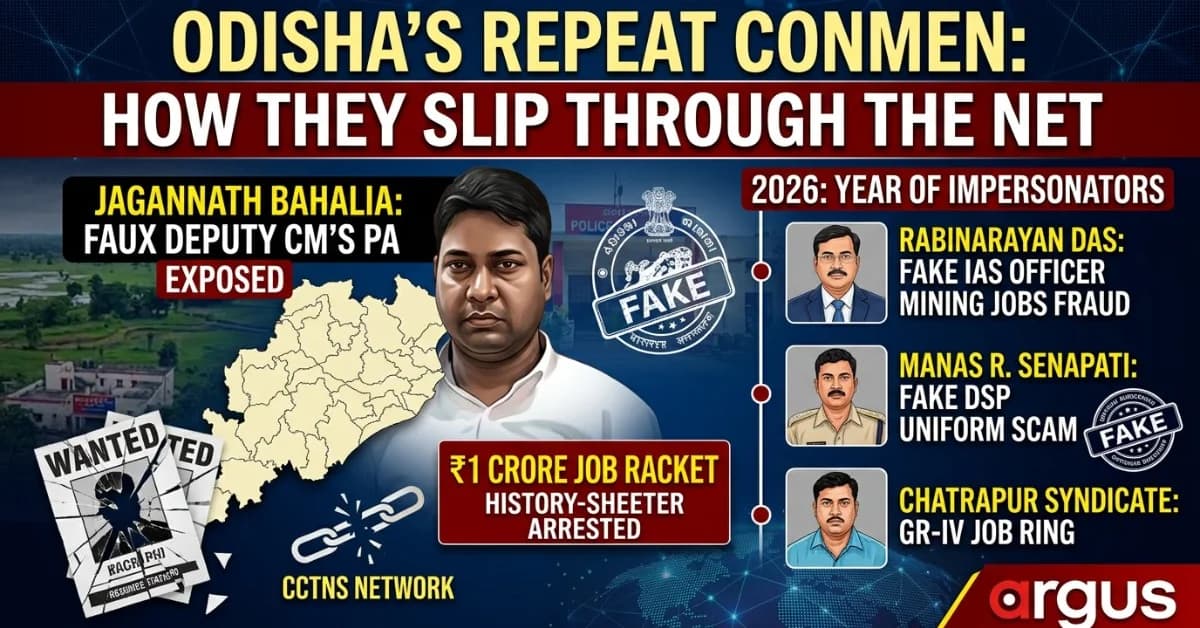
Key Points
Jagannath Bahalia's arrest in Bhadrak highlights a rising wave of high-profile job impersonation rackets across Odisha.
Multiple accused fraudsters, including fake IAS officers and political PAs, were repeat offenders with active prior cases.
Institutional gaps like siloed police stations and reactive policing allow history-sheeters to easily cross districts and reinvent scams.
Bhubaneswar: For conmen masquerading as powerful government officials, ministers’ personal assistants, and even IAS officers, Odisha appears to have become fertile ground.
The
arrest of Jagannath Bahalia in Bhadrak has brought this institutional
problem into sharp focus. His arrest on Wednesday marks the fourth
major high-profile impersonation case reported in Odisha in the last
nine months.
It exposes a disturbing pattern: several of these
fraudsters were repeat offenders who continued moving from one
district to another, reinventing themselves to target desperate job
aspirants before the police finally closed in.
The mushrooming of these impersonators – ranging from a fake IAS officer to a man posing as a Deputy Chief Minister’s PA and another wearing a counterfeit DSP uniform – raises a critical question: why are known offenders repeatedly being given the room to reinvent themselves?
The Bahalia case is particularly revealing. Investigators found that he was already a history-sheeter with active cases registered against him in Bhadrak, Balasore, and Cuttack. Yet, he managed to rent a house in Bhadrak, cultivate an aura of immense political influence, and allegedly run a job racket worth more than Rs1 crore before police tracked him down to Digha in West Bengal.

📱 Get Argus News App
✨The Conmen's Trail: From Fake Officials to Repeat Offenders
The cases emerging in 2025 and 2026 demonstrate that impersonation-based job fraud is no longer just about generating a fake appointment letter. The newer breed of conmen systematically sells access to power.
|
Year |
Case Name |
Modus Operandi |
Criminal History & Legal Status |
|---|---|---|---|
|
2025 |
Byasadev Rana
Impersonated a Section Officer of the Panchayati Raj Department; used a forged identity card and security passes to enter Lok Seva Bhavan and allegedly cheat job seekers of ₹20 lakh.
Arrested; currently under trial.
2026
Rabinarayan Das
Posed as a promoted IAS officer and allegedly promised OMC jobs in exchange for ₹20 lakh.
History-sheeter with active cases at Lingaraj PS and Jajpur Cyber PS.
2026
Jagannath Bahalia
Posed as the PA to an Odisha Deputy Chief Minister; allegedly collected over ₹1 crore from job aspirants by promising railway jobs.
Multiple prior cases registered across Bhadrak, Balasore, and Cuttack.
2026
Manas Ranjan Senapati
Donned a counterfeit police uniform and insignia, posing as a DSP to promise police department jobs.
Previously arrested by Ranapur Police in 2022 over identical allegations.
2026
Chatrapur Syndicate
Operated a coordinated ring posing as fake block/data-entry officials, issuing fraudulent Grade-IV appointments.
First-time arrests; operated unchecked for over a year before being busted.
The pattern is striking.
Of the four major impersonation cases identified in 2026, three involved accused individuals who already possessed active criminal records, according to available police reports.
This completely changes the character of the problem. These were not phantom criminals appearing out of nowhere. In most instances, law enforcement already had their names, biometric identities, and previous allegations logged somewhere in the system.
The core issue, therefore, is less about how cleverly these men fabricated their fake identities, and more about why their existing criminal profiles failed to trigger an early police response.
July to September: Two Cases, One Chilling Template
The cases of Rabinarayan Das in July 2026 and Jagannath Bahalia in September 2026 provide the clearest illustration of this policing gap.
Das presented himself as a promoted IAS officer of the Odisha Government, leveraging that elite administrative identity to lure victims with the promise of Odisha Mining Corporation (OMC) jobs.
Yet, when Commissionerate Police examined his background post-arrest, they discovered he already had a pending case at Lingaraj Police Station in Bhubaneswar and a separate cyber-fraud case at Jajpur Cyber Police Station. Despite that active record, he managed to launch an entirely new Rs20-lakh operation unimpeded.
Bahalia followed an almost identical script, swapping a bureaucratic disguise for a political one.
He posed as the personal assistant to a Deputy Chief Minister, displayed strategically taken photographs with senior political leaders, and claimed direct links to the highest echelons of government.
He demanded Rs15 lakh from one job aspirant for a railway appointment, forcing the victim's family to sell their ancestral land to arrange the cash. Bahalia went so far as to issue a counterfeit railway call letter and even scheduled a physical joining process at the DRM office in Khordha.
By the time the victims realized they had been duped, he had gone underground. He switched off his mobile phones, jumped between rented properties, and ultimately crossed the state border into West Bengal to hide out in Digha. Police were forced to form a specialized tracking team just to trace his digital footprint.
The similarity is impossible to ignore.
Both men had pre-existing police cases. Both reinvented themselves using the borrowed aura of government authority. Both easily crossed jurisdictional boundaries, and both continued operating until a fresh, multi-lakh fraud forced an intensive, reactive police response. This creates an uncomfortable impression that the sheer financial size of the fraud has become the primary trigger for serious police action.
What Was the Union Government's Plan?
This is precisely the type of jurisdictional exploitation that the Union Government's digital policing architecture was designed to eradicate.
The Crime and Criminal Tracking Network & Systems (CCTNS) was implemented nationwide to connect police stations and make real-time criminal information accessible across jurisdictions. In principle, a suspect with cases in Cuttack or Balasore should not become an invisible entity the moment he steps into Bhadrak.
The broader national cybercrime infrastructure, including the National Cyber Crime Reporting Portal and integrated national databases, is similarly geared toward helping state police forces identify financial and fraud patterns before criminals can exploit regional boundaries. The philosophy is simple: criminal intelligence must travel faster than the criminal.
However, the Bahalia case exposes a massive gulf between owning a state-of-the-art digital network and actually utilizing it as an active, preventative policing tool.
Where the Odisha Police Radar Failed
The institutional failure can be broken down into four distinct structural blind spots:
Breakdown of Inter-District Intelligence: Bahalia's previous cases were spread across Bhadrak, Balasore, and Cuttack. Yet, he successfully established a new operational base inside Bhadrak from a rented house without triggering a single local flag or neighborhood verification alert.
Siloed Functioning of Police Stations: An FIR remains meaningful only if it translates into an active lookout, field intelligence, or routine digital surveillance. If a suspect can move to an adjacent district/ adjacent police station area without the new police jurisdiction instantly viewing his criminal history as an actionable warning, the digital network loses its entire preventive value.
Strictly Reactive Policing: In Bahalia's case, it required a fresh fraud crossing the Rs1-crore threshold and the subsequent mobilization of a dedicated tracking team to produce a breakthrough. The system reacted to the crisis rather than preventing it.
A Slow-Moving Legal Cycle: A review of these impersonation files shows that accused individuals spend months as undertrials, while the actual trials stretch for years due to witness intimidation, complex multi-district jurisdictions, and procedural delays. This allows seasoned conmen to secure bail, exit the system, and rebuild their fraud networks under fresh aliases before their past crimes ever reach a final conviction.
Ultimately, a clever conman does not need to permanently defeat the police. He only needs to stay ahead of the system long enough to extract money, disappear, and start over.
The four 2026 cases suggest that impersonation has evolved into a highly specialized form of enterprise in Odisha – one where the primary currency is no longer just forged paper, but borrowed authority.
The
Big Lesson Here: Until police intelligence becomes genuinely
real-time across districts, a history-sheeter will continue to
transform into a "new" conman simply by changing his
address, his phone number, and his uniform.
Also Read: Special Report| How an anxious first-year MBBS student Sagar Sahoo's eight-day disappearance exposed the blind spots of Odisha's digital-first policing
Related Topics
Explore more stories