



ED raids Wellfare Group in ₹2,000-cr scam: Will Odisha’s duped investors finally get their money back?
Key Points
Bhubaneswar: The Enforcement Directorate’s Bhubaneswar Zonal Office has intensified its money-laundering probe into M/s Wellfare Buildings and Estates Pvt Ltd (WBEPL), a multi-state deposit and real-estate fraud case that has now assumed a much larger dimension than initially estimated.
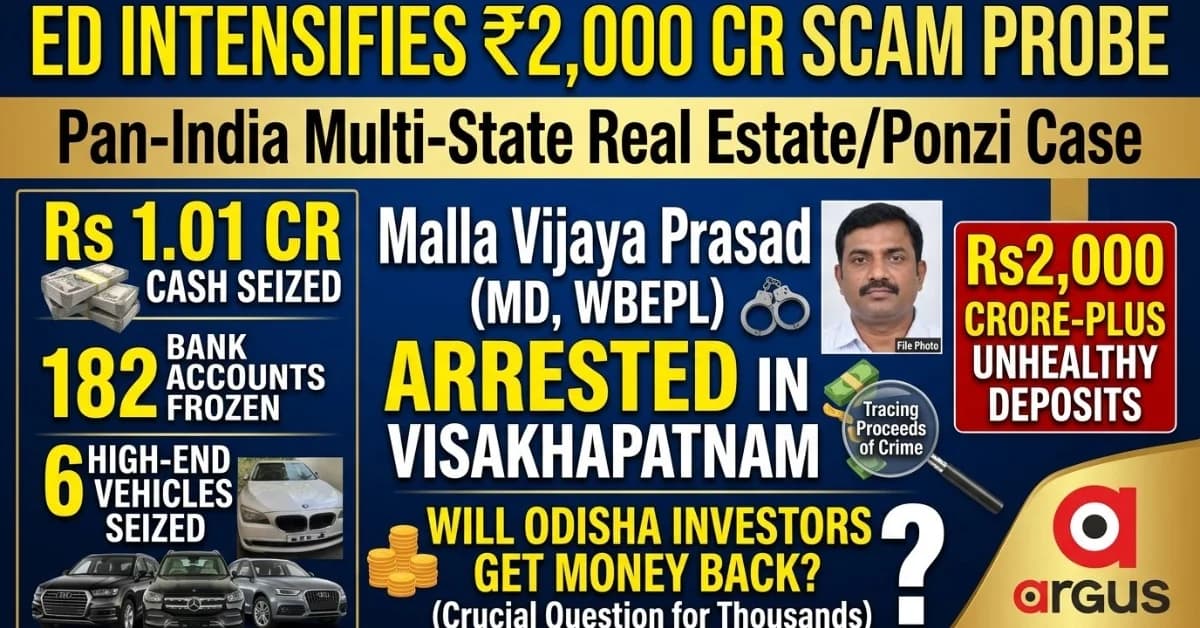
In searches conducted on August 5 at five premises linked to the company and its directors in Visakhapatnam and Hyderabad, the ED seized Rs1.01 crore in cash, property-related documents and digital devices, besides freezing 182 bank accounts and six high-end vehicles.
The agency has now put the unauthorised mobilisation of public deposits at more than Rs2,000 crore, raising a crucial question for thousands of investors, including those in Odisha: will the latest asset-tracing and freezing action finally pave the way for recovery of their money?
From real-estate promise to Odisha EOW arrest

📱 Get Argus News App
✨WBEPL was registered as a corporate entity and operated from Visakhapatnam, projecting itself as a real-estate and infrastructure player.
According to the ED investigation, the company mobilised public money through investment and deposit schemes, with investors in Odisha allegedly lured by promises of high returns and, in several cases, allotment of physical plots in Visakhapatnam. The company subsequently failed to honour these commitments.
The Odisha connection is not new. A complaint had been registered in the State in 2019, following complaints from investors.
The Odisha Crime Branch’s Economic Offences Wing (EOW) subsequently investigated the case and, on September 6, 2021, arrested WBEPL Managing Director Malla Vijaya Prasad from his residence in Visakhapatnam on charges relating to cheating, forgery and criminal breach of trust. The Odisha case thus became one of the important predicate offences feeding into the subsequent multi-agency investigation.
The ED has now brought together the Odisha EOW case with investigations and chargesheets originating from the CBI, ACB Dhanbad, Odisha Police and SFIO, giving the case a pan-India financial-fraud dimension.
The agency says its investigation has found a Ponzi-like mechanism in which fresh collections were used to repay earlier investors, while financial statements were manipulated and funds diverted through transactions and assets.
Rs2,000 crore-plus scam across five states
The significance of the latest ED action lies in the scale of the alleged fraud. What began as complaints by investors in individual states has now been traced to a network spanning Odisha, West Bengal, Bihar, Jharkhand and Andhra Pradesh, with the wider corporate and financial footprint also extending into Telangana. The ED has pegged unauthorised public deposit mobilisation at more than ₹2,000 crore.
|
State/region |
Known value in available records |
Nature of footprint |
|
Odisha |
~₹2 crore |
Branches in Bhubaneswar, Nayagarh and Narasinghpur; investors allegedly promised high returns/Visakhapatnam plots |
|
Andhra Pradesh |
Not separately disclosed |
Major operational and financial base; Visakhapatnam headquarters |
|
Jharkhand |
Not separately disclosed |
CBI cases involving Chaibasa and Tiliya-Koderma branches |
|
Bihar |
Not separately disclosed |
Covered by CBI-linked investigation |
|
West Bengal |
Not separately disclosed |
Corporate registration/operational footprint |
|
Telangana |
Not separately disclosed |
Assets and financial links traced in Hyderabad |
Pan-India alleged deposit mobilisation: Rs2,000 crore-plus.
The available ED material does not provide a verified state-wise monetary breakup for the other states; hence the absence of figures in the table is itself important. The scale of the Odisha loss cannot simply be inferred from the overall Rs2,000-crore figure.
Why did ED action come in 2026 when the case dates back to 2019-21?
This is perhaps the most important question arising from the latest development.
The gap does not necessarily indicate that the fraud investigation remained dormant. The Odisha case began at the police/EOW level in 2019, while the high-profile arrest came in 2021. The ED’s role is different: its PMLA investigation is aimed not merely at establishing that investors were cheated but at tracing the proceeds of that crime, identifying how the money was layered or diverted and locating assets acquired from those proceeds.
The multi-state nature of the alleged fraud also complicated the process. Investigators had to bring together the Odisha EOW case with CBI and other agency proceedings in Bihar and Jharkhand and establish the financial links between branches, directors, bank accounts and properties. The ED says its investigation has now traced proceeds through multiple accounts and assets and has consequently invoked its powers under the PMLA to search, seize and freeze them.
In other words, the 2019-21 police action was primarily about the alleged cheating; the 2026 ED action is about following the money and securing the alleged proceeds of that crime.
Will Odisha investors get their money back?
The latest action certainly raises hopes but does not yet guarantee repayment.
For the first time in this case, substantial assets directly linked to the accused have come under the ED’s financial enforcement net. The agency has seized Rs1.01 crore cash, frozen 182 bank accounts and acted against six luxury vehicles, besides taking possession of property documents and digital evidence that could help establish the wider money trail.
More importantly for investors, the investigation is not restricted to cash. The ED is examining immovable properties and other assets allegedly connected with the diversion of investor money. If such assets are ultimately established as proceeds of crime and are legally attached/confiscated, the PMLA framework provides a route for restoration to legitimate claimants. The ED itself states that its restitution mechanism under Sections 8(7) and 8(8) can facilitate restoration of properties/assets to genuine claimants.
Its latest published data shows that Rs63,142.65 crore worth of properties/assets has been restored to victims or legitimate claimants across cases, demonstrating that restitution is not merely theoretical.
But there is a major caveat. Rs1.01 crore in cash and the vehicles are only a fraction of an alleged Rs2,000-crore-plus fraud. The real recovery prospects for Odisha investors will therefore depend on how much of the alleged proceeds can be identified in bank accounts and immovable properties, whether those assets withstand legal scrutiny and how quickly the claims of genuine investors can be verified.
For
thousands who have waited since the original complaints in Odisha, therefore,
the ED action is a significant first step towards recovery, not yet the
recovery itself. The real test will be whether the trail from the frozen
accounts and identified properties ultimately leads back to the investors whose
money disappeared years ago.
Also Read: Narcotics Trade Changing Face in Odisha: Women Emerging Key Driver of Brown Sugar Trade in State| Special Report
Related Topics
Explore more stories