



Decoding Sundargarh Maoist Ammunition Dump Bust By Odisha Police: Key Details Inside| Special Report
Key Points
Bhubaneswar: As Union Home Minister Amit Shah pushes towards his stated policy of making India Naxal-free, it seems the depleted and decapitated Jharkhand-based Maoist command have suffered another major jolt at the hands of Odisha Police.
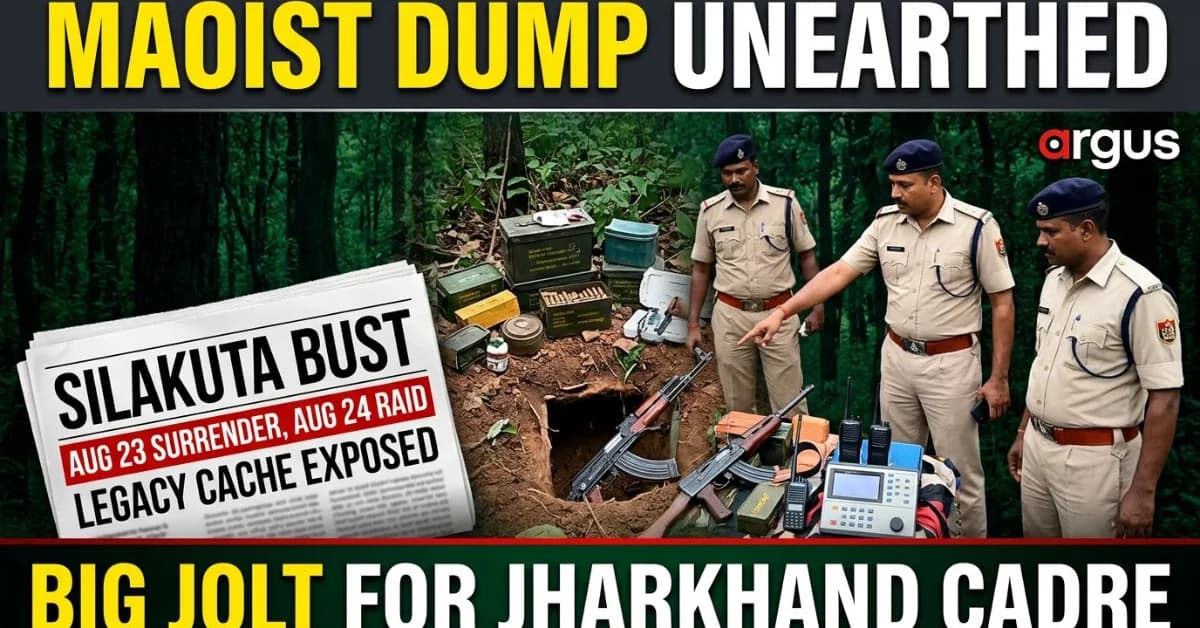
A concealed Maoist ammunition and logistics dump, believed by security agencies to be part of the old insurgent infrastructure built up years ago, has been neutralised in a single operation in the Silakuta Reserve Forest.
And the timing is significant.
What the Rourkela SP officially disclosed?

📱 Get Argus News App
✨According to the official briefing issued by the Rourkela Police District on August 24, “Acting on information obtained during the interrogation of surrendered Maoists, a joint team of the DVF and BDDS conducted a search and area-domination operation in the Silkuta Reserve Forest area under K. Balang police station”.
August 23 surrender, August 24 bust: How did it happen so fast?
The sequence is striking. A Maoist cadre formally surrendered on August 23.
Within roughly 24 hours, police teams were inside the Silakuta Reserve Forest, supported by a bomb disposal unit, searching a specific zone and eventually recovering the concealed cache.
How this become Possible?
Here's the Real Story
Surrender is a Process, Not an Event. Maoist cadres rarely walk into a police station unannounced to surrender.
The formal surrender on August 23, 2026, was the culmination of weeks – sometimes months – of back-channel negotiations mediated by family members, local intelligence networks, or police handlers.
Before a formal surrender is accepted and publicized by senior officials like the Rourkela SP, the police quietly verify the cadre's identity, rank, and the value of their intelligence.
And, as a part of these secret pre-surrender talks, cadres are often required to provide actionable, high-value data – such as the exact coordinates of a major arms dump – to prove they are genuine and not plant double agents. The police likely had the core information before the public announcement on August 23.
Finally, the moment a cadre names a location like the Silkuta Reserve Forest, intelligence wings don't just run into the woods. They map the coordinates against existing satellite imagery, drone surveillance data, and known historical movement tracks of that specific Maoist division.
It needs worth mentioning here that security forces maintain a deep grid of "suspected dump zones."
If the surrendered cadre's mental map perfectly matches a blind spot or a suspected area already flagged by police tracking, the intelligence is instantly upgraded to "high probability," justifying an immediate tactical strike.
The 24-Hour Rush In the dense terrain bordering Jharkhand, news travels fast. The moment a cadre absconds or goes missing to surrender, their former commanders assume that all secrets known to that cadre are compromised.
If the District Voluntary Force (DVF) had waited 3 to 4 days to verify the data through traditional scouting, remaining active Maoist sympathizers or couriers would have cleared out the AK-47, IED, and communication gear to relocate them to a new cache. The 24-hour window is a tactical necessity to "freeze" the logistics before the insurgents realize a leak has occurred.
The Rehabilitation File: Under Odisha's state policy, the financial rewards and legal immunities granted to a surrendered insurgent are strictly contingent on the accuracy of the information they provide. If the DVF and Bomb Detection Squad had dug up the Silkuta forest and found nothing, the cadre's surrender package would be stalled, and they could face immediate prosecution as an active insurgent rather than a rehabilitated citizen.
The successful recovery serves as the ultimate validation of the cadre's cooperation.
The 24-hour window indicates that the police acted on pre-vetted intelligence that was officially logged the moment the surrender paperwork was formal.
What This Bust Signifies?
The 24-hour turnaround and the items recovered send a definitive message regarding the status of Left-Wing Extremism (LWE) in India.
The battle has fundamentally shifted from active, high-casualty jungle warfare to intelligence-led forensic cleanup. The police are no longer just fighting active squads; they are systematically erasing the physical remnants, ordnance, and deep-forest infrastructure left behind by a dismantled movement.
The Psychological Domino Effect: The bust is a symptom of extreme internal paranoia within the Naxal ranks. Because the location was revealed within hours of a cadre surrendering, it proves to the remaining leadership that none of their secrets are safe, triggering panic and forcing remaining members to abandon their hideouts.
Closing the Inter-State Loophole: Historically, Maoists exploited the lack of coordination between different state police forces by committing a crime in Jharkhand and hiding in Odisha (or vice versa). This operation signifies absolute, seamless inter-state intelligence sharing. The Odisha police acted rapidly on data regarding a cross-border division, proving that the state boundary lines no longer offer protection to insurgents.
A four-year-old reserve that could have become a lifeline
The recovery assumes significance because the Silakuta forest lies in Sundargarh's sensitive inter-state insurgency corridor, historically linked to the Maoist network operating out of Jharkhand's South Chhotanagpur-Saranda belt.
Sundargarh was never merely an isolated Odisha pocket for the Maoists. Its forests and porous border offered an operational bridge. Cadres could move across the Odisha-Jharkhand boundary, use dense terrain as cover and rely on deep-forest infrastructure – including hidden arms and logistics dump – for their movements.
That is what made a cache like the one recovered from Silakuta potentially important.
The Silkuta Reserve Forest Dump Location: K. Bolang limits, Sundargarh district (Odisha-Jharkhand border).
The Seizure: A surgical 24-hour deployment based on a surrendered insurgent's map unearthed a four-year-old master dump.
Recovered Hardware: 1 AK-47 rifle variant, 1 CM 9mm 1A1 Carbine, 2 high-capacity magazines, 1 specialized IED container, 15 active detonators, 20 rounds of 9mm ball ammunition, and high-frequency Motorola walkie-talkies integrated with a Kaiweets KM100 digital multimeter used to build electric IED triggers.
The carbine is also of particular significance. For an insurgent network whose access to arms and organised supply chains has been steadily choked, the loss of even one serviceable automatic weapon is not merely a numerical reduction in its arsenal. It is a loss of a ready-to-use capability.
The three-year tightening of the Sundargarh noose
The Silakuta recovery did not happen in isolation. It came after years of security pressure that gradually changed the nature of the Maoist challenge in Sundargarh. The district, particularly its forested border belt adjoining Jharkhand, was once part of a wider insurgent geography. Maoist-linked formations had used the terrain to build transit routes, establish local guerrilla infrastructure and maintain hidden weapons and explosives.
The period of peak violence saw attacks on strategic infrastructure, including the 2009 attacks on railway installations in the region. Over the years, security forces responded with deeper combing, the deployment of specialised units and sustained operations across the border belt. The pressure steadily narrowed the Maoists' physical space.
By the 2023-26 period, the nature of the challenge had visibly shifted.
The May 2025 Heist: An armed gang intercepted a commercial logistics truck traveling through the K. Balanga police limits (Sundargarh) near the Saranda forest border, looting 4 tonnes of industrial-grade CDET gelatin sticks intended for local mining quarries.
The 3-Tonne Forest Cache Seizure (May 2025): Within 72 hours of the heist, an intense multi-agency dragnet by the Odisha and Jharkhand police tracked the suspects into the inter-state border forests, successfully unearthing and securing 3 tonnes of the looted explosives before they could be transferred to core guerrilla units.
The Saranda Forest Intercept (June 2025): Continuing the tactical sweep, Rourkela Police and Jharkhand forces engaged Maoists in a fierce gunfight in the Tirilposh area (Jareikela, Jharkhand). Following the clash, security forces uncovered an additional hidden cache containing 2.5 tonnes of explosives and halted two smuggled mini-trucks.
The Final 3.8-Tonne Stockpile Recovery (June 2026): A Special Investigation Team (SIT) led by the Additional SP executed a high-value raid directly on the exact border perimeter, recovering 3,811.30 kg of the remaining hidden explosives inventory and arresting key local logistics assets.
Why This Specific Bust is Unique
While it is not the first recovery, it is considered the most significant logistical seizure in recent years because it happened after the district was declared structurally clear of active operating squads.
Direct Impact of the Silkuta Hideout Bust
While the Silkuta dump in Sundargarh was a "legacy cache" (hidden roughly four years ago), its unearthing deals a multi-layered blow to the remaining Jharkhand-based fighters:
Choking the retreat supply chain: As security forces systematically corner the remaining cadres in Jharkhand's Saranda forest, the fighters' primary survival strategy is to flee across the porous border into Odisha. This dump was explicitly designed as a pre-stocked survival station. Losing it means fleeing cadres have no fresh weapons, ammunition, or food to sustain a cross-border escape.
Irreplaceable Firepower Loss: For a dying insurgency, automatic weapons like the recovered Carbine/AK-47 variant are impossible to replace. With their supply lines and factory networks dismantled, losing even a single automated rifle permanently reduces a squad's offensive capability.
Neutralization of IED Capabilities: The recovery of 15 active detonators and a digital multimeter (used to test detonation circuits) directly pre-empted lethal booby-trap operations. It deprives the local guerrilla squads of the tools needed to slow down advancing police units using landmine.
Also Read:Chandaka Car Theft: How CCTV, Rain and a Muddy Trail Helped Police Crack the Towing Robbery| Special ReportRelated Topics
Explore more stories