



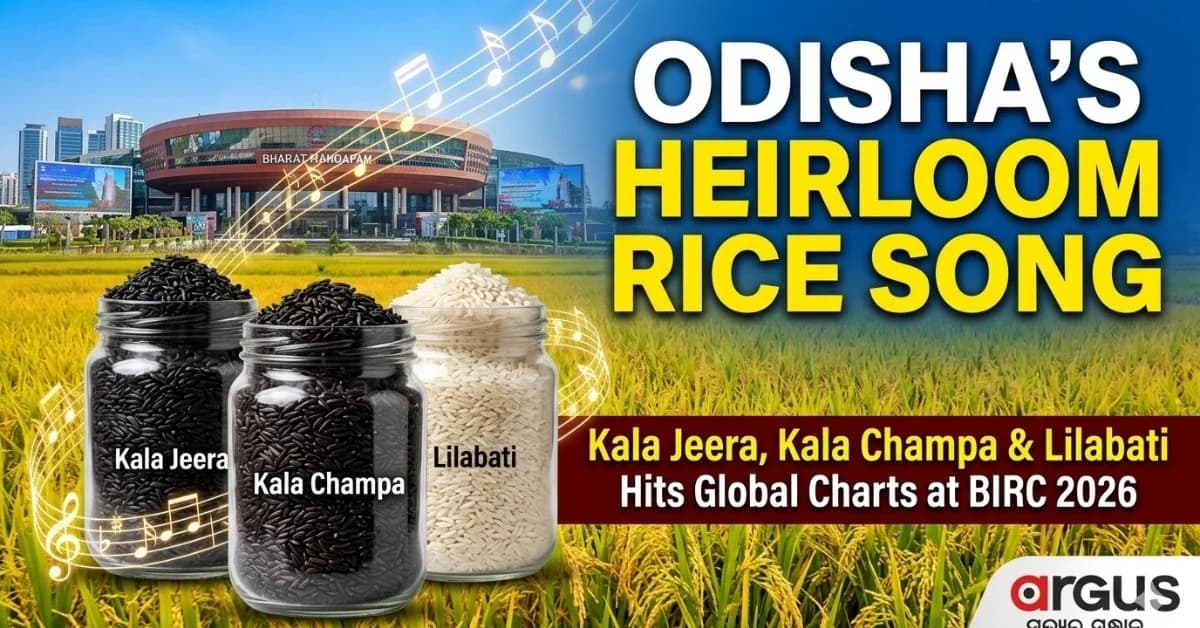
Special Report| From Kala Jeera to Lilabati: Odisha’s Heirloom Rice Song Tops Global Agribusiness Charts at BIRC 2026
Key Points
Odisha secured over Rs68 crore in business pipelines and 5,300 quintals in purchase orders at the Odisha Healthier Rice Business Summit 2026.
ORMAS is showcasing 15 indigenous and GI-tagged rice varieties from eight districts at the Bharat International Rice Conference (BIRC) 2026.
A strategic pioneer cohort of 3,695 farmers across 85 CBOs is being leveraged to ensure strict quality control and eliminate predatory middlemen.
Bhubaneswar: Odisha’s economic engine is tuning into a powerful new duet.
The state’s new BJP government is seamlessly synchronising corporate industrial strategy with agricultural heritage, setting Odisha’s traditional rice story to a global tune.
If the early response at the international box office is any indication, Odisha's heirloom rice song is about to top the global agribusiness hit parade.
After raking in a tentative business pipeline of over Rs68 crore and locking in immediate purchase orders exceeding 5,300 quintals from 35 national buyers and three international importers earlier this month at the Odisha Healthier Rice Business Summit 2026 in Bhubaneswar, the State took a giant leap forward to capture the prestigious ‘Platinum’ tag at the Bharat International Rice Conference (BIRC) 2026.

📱 Get Argus News App
✨Moving decisively away from its historical reputation as a producer of low-cost, bulk agricultural commodities, the state – spearheaded by the Odisha Rural Development and Marketing Society (ORMAS) under the Panchayati Raj and Drinking Water Department – has arrived on the global stage to pitch something entirely different: agricultural luxury, biodiversity, and ancestral heritage.
Running from October 23 to 25, 2026, the mega event features a carefully curated exhibition of 15 indigenous and Geographical Indication (GI)-tagged paddy and rice varieties sourced from eight distinct districts of Odisha.
This is not merely an exercise in cultural exhibitionism; it is a calculated, aggressive commercial play.
Odisha is attempting to redefine its agricultural economy. By placing its rare, heirloom rice varieties in front of international exporters, premium retail chains, and luxury hoteliers, the state is seeking to transition from subsistence farming to high-margin, climate-resilient global agribusiness.
The Turning Point: Shifting from Volume to Value
For decades, Odisha’s agricultural narrative has been dominated by a single obsession: yield volume.
The Green Revolution incentivised the mass cultivation of high-yielding, uniform white rice hybrids. While this strategy successfully achieved food security, it simultaneously triggered two severe unintended consequences.
First, it stripped smallholder farmers of their economic leverage, turning rice into a low-margin commodity controlled by predatory local middlemen.
Second, it pushed the state's magnificent genetic repository of indigenous paddy varieties to the brink of extinction.
BIRC 2026 represents the official turning point in this narrative.
The Odisha government is actively reversing the old paradigm by declaring that the state’s true agricultural wealth lies not in mass-produced grain, but in its biodiverse exclusivity.
|
Stage / Factor |
OLD PARADIGM (Mass Commodity) |
NEW PARADIGM (Boutique Agribusiness) |
|
Stage 1: Production Focus |
High Yield |
Indigenous Varieties |
|
Stage 2: Input & Resources |
High Water / Chemical Inputs |
Eco-Friendly / Low Input |
|
Stage 3: Market Strategy |
Low Market Price |
High-Value Niche Markets |
|
Stage 4: Value Realization |
Middleman Exploitation |
Direct B2B Wealth |
|
Strategic Outcome |
High dependency, margin erosion |
Premium pricing, direct buyer relationship |
As global consumer preferences undergo a massive post-pandemic realignment toward wellness, functional nutrition, and sustainability, Odisha’s heirloom varieties are suddenly perfectly positioned. They are no longer viewed simply as rustic village food; they are being rebranded as premium superfoods, aromatic delicacies, and therapeutic dietary staples. This strategic pivot aims to capture the immense "value-add" of the global food supply chain and route it directly back to the rural ecosystems that preserved these grains for generations.
The Portfolio of Agribusiness Luxury: A Strategic Breakdown
The 15 varieties showcased at Bharat Mandapam have been selected not just for their rarity, but for their specific alignment with lucrative global market segments. Rather than pitching "rice" as a monolith, ORMAS has segmented its portfolio into distinct commercial pillars designed to appeal to diverse international buyers.
1. PREMIUM LUXURY & SUPERFOODS
· Regional Source & Varieties:
o Koraput: GI-tagged Kala Jeera
o Bargarh: Black Jasmine
o Ganjam: Labanya & Khanipaka (Black Rice)
· Target Global Segment: Elite Health & Wellness, Gourmet Retail, Organic Superfood Enthusiasts
· Commercial & Agronomic Value Proposition: Packed with anthocyanins, iron, and zinc. These varieties command astronomical margins in Western and Middle Eastern markets as antioxidant-rich lifestyle alternatives to standard grains.
2. FUNCTIONAL HEALTH & THERAPEUTICS
· Regional Source & Varieties:
o Jagatsinghpur: Low-GI Rice
· Target Global Segment: Diabetic-Friendly Markets, Clinical Nutrition, Lifestyle/Dietary Sectors
· Commercial & Agronomic Value Proposition: Addresses the exploding global epidemic of metabolic disorders. Offers a culturally seamless, low-glycemic dietary staple for health-conscious consumers without sacrificing texture.
3. GOURMET & AROMATIC FINE DINING
· Regional Source & Varieties:
o Kendrapara: Lilabati
o Mayurbhanj: Salafula, Mugei, & Kala Champa
· Target Global Segment: International Hospitality, High-End Culinary Chains, Premium Rice Exporters
· Commercial & Agronomic Value Proposition: Characterised by delicate, unique floral and earthy aromas. Positioned to challenge the global monopoly of traditional Basmati and Jasmine rice in fine-dining circuits.
4. HIGH-VOLUME INSTITUTIONAL STAPLES
· Regional Source & Varieties:
o Puri: Sarala, Sona Masuri, Puja, & Samrat
o Sundargarh: Kanderahali & Machhakanta
· Target Global Segment: Retail Supermarket Chains, Broad-Scale Importers, Institutional Buyers
· Commercial & Agronomic Value Proposition: Combines structural resilience with excellent cooking qualities. Ideal for establishing a steady, reliable baseline of export volumes to secure long-term trade relations.
The Global Appeal: Why the World Wants Odisha’s Rice
The global food market is currently experiencing a profound transformation. Consumers in Europe, North America, and the Middle East are actively moving away from heavily processed, chemically dependent, monoculture crops. They are willing to pay a steep premium for stories of origin, ecological sustainability, and functional health benefits. Odisha’s portfolio checks every single box.
Take Koraput’s GI-tagged Kala Jeera, often referred to as the "Prince of Rice." Its striking coriander-like aroma, deep black hue, and legendary nutritional profile make it an instant hit for premium organic organic aisles in Dubai or London. Similarly, Black Jasmine from Bargarh and Labanya from Ganjam possess deep pigments that signify massive concentrations of anthocyanins—the same powerful antioxidants found in blueberries.
Furthermore, the Low-GI (Glycemi Index) rice from Jagatsinghpur addresses a massive global public health crisis. With diabetes and insulin resistance surging worldwide, a naturally occurring, pleasant-tasting rice that does not cause sharp blood sugar spikes is an agronomic holy grail. By presenting these varieties at an international forum like BIRC, ORMAS is effectively moving Odisha out of the crowded, low-priced commodity basement and into the elite upper floors of international food retail.
Micro-Scale Loop, Macro-Scale Blueprint
At the heart of this global push is a precisely calibrated human network. A total of 3,695 farming family members, organized across 85 Community-Based Organisations (CBOs)—including Farmer Producer Organisations (FPOs) and Women’s Self-Help Groups (SHGs)—form the backend of this export drive.
To the casual observer, looping fewer than 4,000 farmers in a state with millions of agricultural labourers seems remarkably small. Critics might look at these numbers and question whether an initiative of this scale can truly impact Odisha’s rural economy. However, from an agribusiness standpoint, this tight, restricted loop is not a limitation—it is a sophisticated, intentional strategy.
THE AGRIBUSINESS LIGHTHOUSE STRATEGY
· Phase 1 (The Elite Sandbox): 3,695 Farmers / 85 CBOs ➔ Tight Quality Control ➔ High Export ROI
· Phase 2 (The Lighthouse Effect): Neighbouring Villages Witness Massive Financial Returns
· Phase 3 (Market-Driven Scaling): Mass Adoption of CBO Model ➔ Permanent Rural Wealth Creation
1. The Operational Bottleneck of Global Standards
International trade does not forgive inconsistency. Exporters, luxury hotel chains, and foreign phytosanitary regulators enforce brutal standards regarding moisture content, milling quality, grain length uniformity, and chemical residue limits. If ORMAS had attempted a mass-scale rollout involving hundreds of thousands of unmapped farmers, standardising the post-harvest processing would have been an operational impossibility.
By utilizing a closed "sandbox" of 3,695 farmers, ORMAS can provide intensive, hands-on institutional oversight. They can closely monitor grain purity, organic farming protocols, and modern sorting techniques, ensuring that every bag of rice leaving these 85 CBOs meets uncompromising global standards.
2. Protecting the Premium Brand Equity
Heirloom crops like Mugei, Salafula, or Kala Champa are fundamentally scarce; they are grown in fragile, specific microclimates by ancestral communities. If ORMAS flooded the market with millions of tons of these varieties prematurely, they would commoditize their own asset. The rarity is what drives the premium price. By keeping the initial supply tightly controlled and exclusive, ORMAS can establish a high price floor. Once the brand equity of "Odisha Heirloom Rice" is firmly cemented in the minds of international buyers, the state can systematically expand production zones without risking a price collapse.
3. The "Lighthouse Effect" for Rural De-risking
Farming communities are notoriously risk-averse, and entirely for good reason—one bad season can lead to financial ruin. Farmers will not abandon their familiar, government-subsidized hybrid crops based on promotional rhetoric alone. They need to see undeniable, tangible proof.
The 3,695 pioneer farmers act as an economic "Lighthouse." When these initial 85 CBOs successfully bypass local middle-tier agents, sign direct B2B contracts with global exporters at Bharat Mandapam, and bring life-changing financial returns back to their villages, it will trigger an immediate peer-to-peer demonstration effect. Neighbouring villages will actively demand to join the program, creating an organic, market-driven pull-effect that will scale the initiative safely and exponentially across the state.
De-risking the Supply Chain: Dismantling the Middleman
The ultimate objective of the ORMAS strategy at BIRC 2026 is the total elimination of predatory middle-tier agents who have historically drained the financial lifeblood out of rural Odisha. In the traditional agricultural setup, smallholder farmers living in remote, disconnected areas like Koraput or Mayurbhanj were completely isolated from terminal markets. They had no access to real-time pricing data and lacked the logistics to transport their goods to major trade hubs.
Local aggregators exploited this isolation. They would purchase rare, high-value varieties from impoverished farmers at standard, rock-bottom commodity rates, paying them fractions of the crop's true worth. These middlemen would then clean, package, and resell these exact same grains to national exporters at massive markups. The wealth generated by Odisha’s rich agricultural biodiversity was leaking entirely into the pockets of intermediate traders.
By bringing CBO representatives directly to Delhi, ORMAS has effectively built an institutional bypass.
When an FPO from Kendrapara sits across the table from a global food exporter at Bharat Mandapam, the power dynamic changes completely. Aggregated under CBOs, the farmers possess collective bargaining power and volume leverage. Backed by ORMAS’s modern branding, quality assurance, and logistical support, these rural communities are finally capturing the full wholesale premium of their harvests. The money that once bought a middleman’s fleet of trucks is now being routed directly into the bank accounts of tribal and rural households, turning ancestral agricultural wisdom into a direct engine of rural prosperity.
The Bottomline
As the curtains draw on the Bharat International Rice Conference 2026, Odisha’s agricultural trajectory looks fundamentally altered. The transition from a volume-driven commodity mindset to a value-driven, biodiverse agribusiness strategy is no longer a theoretical policy paper – it is a live, functioning market reality.
By treating its unique
indigenous rice varieties as premium assets, anchoring them with tight quality
controls through a selective pioneer cohort of farmers, and aggressively
cutting out predatory supply-chain leakage, Odisha is setting a profound
example for the global South. The message coming out of Bharat Mandapam is
unmistakable: Also Read: Odisha's ancient rice story is no longer just about feeding
the nation; it is about captivating, nourishing, and sustainably trading with
the world.
Also Read: Special Report | Odisha Sells Agrivoltaic Dreams in Delhi: But is the Ground Reality Rosy?
Related Topics
Explore more stories