



EXCLUSIVE| IEMI 2025: Odisha Slips To 8 Despite EV Growth; 2/100 Purchase Incentive Exposes Yawning Policy Gap in State
Key Points
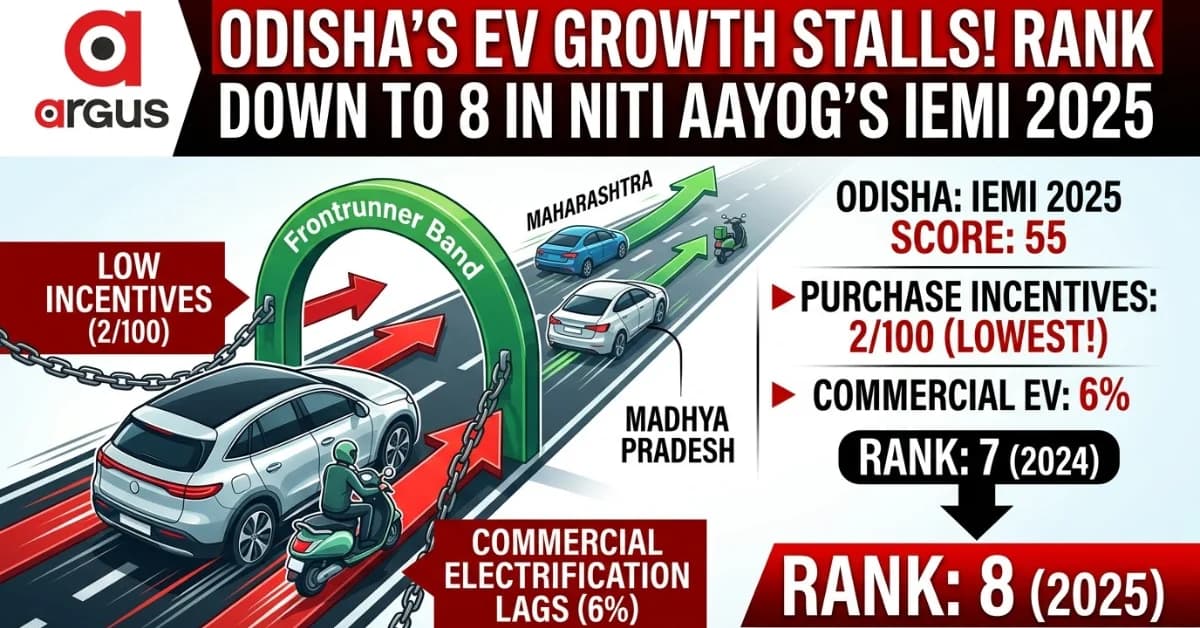
Odisha's composite EV score rose from 49 to 55 in NITI Aayog's IEMI 2025, yet its national rank slipped from 7 to 8 due to faster-moving competitors.
The state faces a major policy gap with a purchase-incentive score of just 2/100 and low commercial EV adoption at 18/100.
Despite infrastructure improvements—including a jump in charging readiness to 57—broader consumer subsidies and R&D expansion remain critical for future growth.
Bhubaneswar: Odisha’s electric vehicle transition has hit a strange stretch of road: the state is successfully building up its range, but its national position has slipped as competitors shift into a higher gear.
The second edition of the India Electric Mobility Index (IEMI) 2025), released by NITI Aayog Wednesday, has placed Odisha at No. 8 nationally with a composite score of 55, compared with rank 7 and a score of 49 in the 2024 edition. In other words, Odisha gained six points in absolute performance but lost one position because several competing States moved faster.
That is the first big takeaway.
The second – and more revealing – finding lies inside the 55-point score.

📱 Get Argus News App
✨Odisha's Purchase Incentives indicator scores only 2 out of 100.
At the same time, the State scores 58 in Transport Electrification Progress, 57 in Charging Infrastructure Readiness and 45 in EV Research and Innovation. The result is a distinctly uneven EV ecosystem: Odisha has a growing market and improving charging readiness, but its demand-side fiscal support and innovation ecosystem remain relatively weak.
The rank fell. The EV ecosystem did not. So what happened?
This is where the IEMI 2025 numbers become important.
The index is not simply a count of how many EVs a State sold. It assesses 16 indicators under three themes:
|
IEMI 2025 theme |
Weight |
|---|
Odisha score
Transport Electrification Progress
50%
58
Charging Infrastructure Readiness
30%
57
EV Research & Innovation
20%
45
Overall IEMI
100%
55
The formula itself explains why Transport Electrification matters so much: it carries half of the total index. Charging infrastructure carries another 30%, while research and innovation account for 20%.
Therefore, weaknesses in consumer incentives, commercial EV adoption and the innovation ecosystem have a disproportionate effect on Odisha's final score.
The ₹1-per-capita problem
The most striking number in the entire Odisha profile is not its 55.
It is Rs1.
NITI Aayog's indicator table records Odisha's annual per-capita purchase incentive allocation at just Rs1, which translates into an indicator score of 2/100.
That is dramatically different from simply saying Odisha has no EV policy.
It does have policy support.
In fact, NITI Aayog identifies one of Odisha's policy features as an interest-free advance for government employees purchasing EVs. But that is a targeted benefit, rather than a broad-based purchase subsidy available across the consumer market.
And that distinction matters.
The IEMI's purchase-incentive indicator is specifically designed to measure financial incentives that reduce the upfront cost of EVs. NITI Aayog says this indicator is based on annual per-capita subsidy allocation and includes State subsidies and fee exemptions, while excluding tax exemptions.
So Odisha's 2/100 is not a measure of whether people like EVs. It is a measure of the State's direct financial demand-side support under the index methodology.
That is the policy gap exposed by IEMI 2025.
Yet Odisha is not a weak EV market
The irony is that the same report shows Odisha has considerable market momentum.
Its 2025 indicator values include:
Private EV registration: 9%
Commercial EV registration: 6%
Governance initiatives: 3
Purchase incentives: ₹1 per capita
Transition initiatives: 1
Operational support initiatives: 2
Fuel-price parity: 20.2
The private EV registration outcome is therefore considerably stronger than the purchase-incentive policy score might suggest.
This creates Odisha's central EV paradox:
The market is moving faster than the State's direct consumer incentive architecture.
That is an important distinction. The IEMI data does not suggest that Odisha's EV transition has stalled. Rather, it suggests that consumer adoption has progressed without a correspondingly strong State-funded purchase incentive framework.
Commercial EVs are the other missing piece
The second major weakness is commercial electrification.
Odisha's commercial EV registration indicator scores only 18/100 in the index framework, even while private EV adoption is much stronger. The commercial gap matters because Transport Electrification Progress carries a 50% weight in the overall IEMI.
The report itself says Transport Electrification is the single largest opportunity for improvement nationally. Among large States, Odisha's theme score of 58 places it in the Frontrunner band, but Maharashtra leads the group at 68.
The contrast becomes sharper when the commercial market is examined.
Odisha's EV transition is not yet equally deep across private mobility, commercial fleets, freight and other high-utilisation segments.
That leaves a policy question for the State's next EV framework:
Can Odisha move from encouraging EV purchases to actively transforming commercial mobility?
Charging infrastructure: Odisha has improved sharply, but the denominator matters
This is the second major part of the story.
Odisha's Charging Infrastructure Readiness score has risen from 43 in IEMI 2024 to 57 in IEMI 2025. That is a substantial 14-point improvement.
But the underlying data tells a more complicated story.
|
Charging indicator |
Odisha's 2025 position |
|---|---|
|
Charger-to-vehicle ratio |
7.9 per lakh vehicles |
|
Capital subsidy for public charging |
1 initiative |
|
Charging infrastructure development initiatives |
2 |
|
Building bye-laws |
2 |
|
Renewable-energy generation capacity share |
10.6% |
|
Power availability deficit |
0% |
The 7.9 chargers per lakh vehicles is the raw indicator value. The corresponding normalised IEMI indicator score is what determines Odisha's performance in the index; it should not be confused with a literal 37 chargers per lakh vehicles.
This distinction is important because the State's EV fleet is growing.
As more electric vehicles enter the market, infrastructure must grow not merely in absolute numbers but faster enough to maintain charging availability relative to the vehicle base.
That is why the report uses the chargers-to-vehicles ratio, defined as public charging points per lakh registered vehicles.
The policy-versus-execution divide
Odisha does have a number of structural advantages.
Its charging framework includes provisions covering public charging capital support, charging-development initiatives and building bye-laws. The State's overall charging score has consequently risen to 57.
But the national comparison shows how quickly other States are moving.
|
Large State |
IEMI 2025 score |
Charging readiness |
Transport electrification |
|---|---|---|---|
|
Maharashtra |
78 |
91 |
68 |
|
Karnataka |
73 |
97 |
55 |
|
Tamil Nadu |
61 |
73 |
48 |
|
Madhya Pradesh |
59 |
48 |
62 |
|
Odisha |
55 |
57 |
58 |
|
Andhra Pradesh |
52 |
62 |
53 |
|
Haryana |
51 |
91 |
19 |
The comparison produces an important analytical point: there is no single Indian EV model.
Haryana, for example, has extremely strong charging readiness but very low transport-electrification progress. Uttar Pradesh shows almost the reverse pattern. NITI Aayog specifically uses these contrasting cases to demonstrate that infrastructure and vehicle adoption are moving at different speeds across States.
Odisha's biggest missed opportunity may now be commercial mobility
The State's next jump in the index will therefore depend on more than adding charging points.
The IEMI data suggests three pressure points:
1.
Consumer incentives:
The
2/100
purchase-incentive score
leaves Odisha with a very small demand-side financial lever compared
with States that provide stronger purchase support.
2.
Commercial transition:
The
18/100
commercial EV adoption score
shows that private consumer adoption has not translated
proportionately into commercial fleet electrification.
3.
Innovation:
Odisha's
EV Research and Innovation score is only 45.
NITI Aayog's large-State comparison shows Maharashtra, Karnataka and
Tamil Nadu far ahead on this dimension, reflecting their deeper
automotive, technology and startup ecosystems.
Why Maharashtra, Karnataka and Tamil Nadu are pulling away
The national picture is changing rapidly.
Maharashtra scored 78 and Karnataka 73, the only two Large States to enter the Top Performer category. Tamil Nadu scored 61 and Madhya Pradesh 59. Odisha's 55 places it in the Frontrunner category alongside several other large States.
The difference is not simply about vehicle sales.
Karnataka leads the country in Charging Infrastructure Readiness with 97, while Maharashtra scores 91. Tamil Nadu scores 73. Odisha's 57 therefore leaves a substantial infrastructure gap even though the State has improved sharply from its 2024 score.
Research is another dividing line. Maharashtra scores 85, Karnataka 82 and Tamil Nadu 77 in EV Research and Innovation. NITI Aayog says research and innovation capacity remains concentrated in industrialised States and urban regions.
For Odisha, therefore, the next phase is not merely about getting more people to buy electric vehicles.
It is about creating an ecosystem around them.
And then came Madhya Pradesh
Perhaps the biggest warning for Odisha comes not from Maharashtra or Karnataka but from Madhya Pradesh.
MP jumped from 23rd in IEMI 2024 with a score of 31 to seventh in 2025 with a score of 59 -a gain of 16 positions. NITI Aayog attributes the rise to progress across multiple indicators, including policy, charging infrastructure and ecosystem development.
This explains why Odisha's six-point score improvement was not enough to preserve its earlier rank.
The race is no longer static.
A State can improve and still fall because another State has improved faster.
That is exactly what happened to Odisha.
The methodology itself changed – another reason to read the rank carefully
There is one important caveat.
IEMI 2025 is not an exact carbon copy of IEMI 2024.
NITI Aayog introduced separate categories for Large States, UTs and City States, and Hilly and Northeastern States. It also changed several data sources, including using BEE data for chargers, revised the fuel-price calculation to a 365-day average, moved policy scoring to a pro-rata basis depending on how long a policy was active, and renamed the charging metric from "EVs per EV charger" to "Chargers to Vehicles Ratio."
The index also uses both absolute and relative scoring. Private and commercial EV adoption, purchase incentives, fuel-price parity, chargers per lakh vehicles, renewable-energy share, power availability, startups and patents are relatively scored against other States and UTs.
Therefore, the movement from 7 to 8 should not be interpreted as a simple year-on-year deterioration in Odisha's EV ecosystem.
The State's score actually rose from 49 to 55.
The rank slipped because the competitive field changed – and because the methodology itself was refined.
What NITI Aayog is effectively telling Odisha
The report's recommendations for Odisha are unusually clear.
It calls for:
EV conversion-kit subsidies
Reserved EV parking
Low-emission zones
Enhanced purchase subsidies
Reduced electricity tariffs for public charging
A single-window system for charging infrastructure
R&D centres for skill development
That list is revealing.
It suggests Odisha's next EV policy challenge is not necessarily to invent another ambitious 2030 target.
It is to close the implementation gap between the target and the consumer, the charger and the commercial fleet.
The Odisha EV paradox in one table
|
What Odisha is doing well |
Where the index exposes a gap |
|---|---|
|
Overall score rose 49 → 55 |
National rank slipped 7 → 8 |
|
Transport Electrification 58 |
Purchase incentives only 2/100 |
|
Charging Readiness 57 |
Charger-to-vehicle ratio remains a constraint |
|
Private EV registration 9% |
Commercial EV registration only 6% |
|
Governance initiatives score strongly |
Direct consumer fiscal support remains limited |
|
Interest-free EV advance for government employees |
Benefit does not represent a broad consumer subsidy |
|
Charging framework has improved |
Infrastructure must keep pace with a growing EV base |
|
R&D initiatives exist |
EV innovation score remains 45 |
What this means for Odisha
The IEMI 2025 verdict is therefore more nuanced than "Odisha falls in EV ranking."
The real story is:
Odisha's EV market is advancing, but its policy architecture is not advancing uniformly across demand incentives, commercial electrification, charging density and innovation.
The State has moved from 49 to 55, enough to enter the IEMI's Frontrunner band, and its charging-readiness score has risen sharply.
But the 2/100 purchase-incentive score is now impossible to ignore.
So is the 18/100 commercial EV adoption score.
And while Odisha has improved, the national field is moving rapidly. Delhi, Maharashtra, Karnataka and Goa occupy the top four positions, while Madhya Pradesh's dramatic rise shows how quickly the leaderboard can change.
For Odisha, the next IEMI battle will therefore not be won simply by selling more electric two-wheelers.
It will depend on whether the State can turn EV policy into a broader consumer incentive system, electrify commercial mobility, expand chargers in proportion to the vehicle fleet and convert its R&D initiatives into an actual EV innovation ecosystem.
That
is the gap between 55
today and the next level of electric mobility tomorrow.
Also Read: EXCLUSIVE | Odisha BJP vs BJD Sports Strategy: Sambalpur Football Academy Emerges as Western Odisha’s New Sporting Power Play
Related Topics
Explore more stories