



2 Years After Looking East With Singapore Trip, CM Mohan Majhi Tour To UAE In West: Can Odisha Turn A Magnet For Dubai Investors?| Exclusive
Key Points
Bhubaneswar: Nearly two years after Chief Minister Mohan Charan Majhi first looked east towards Singapore to scout investments for Odisha, the State is now turning westwards towards the Gulf.
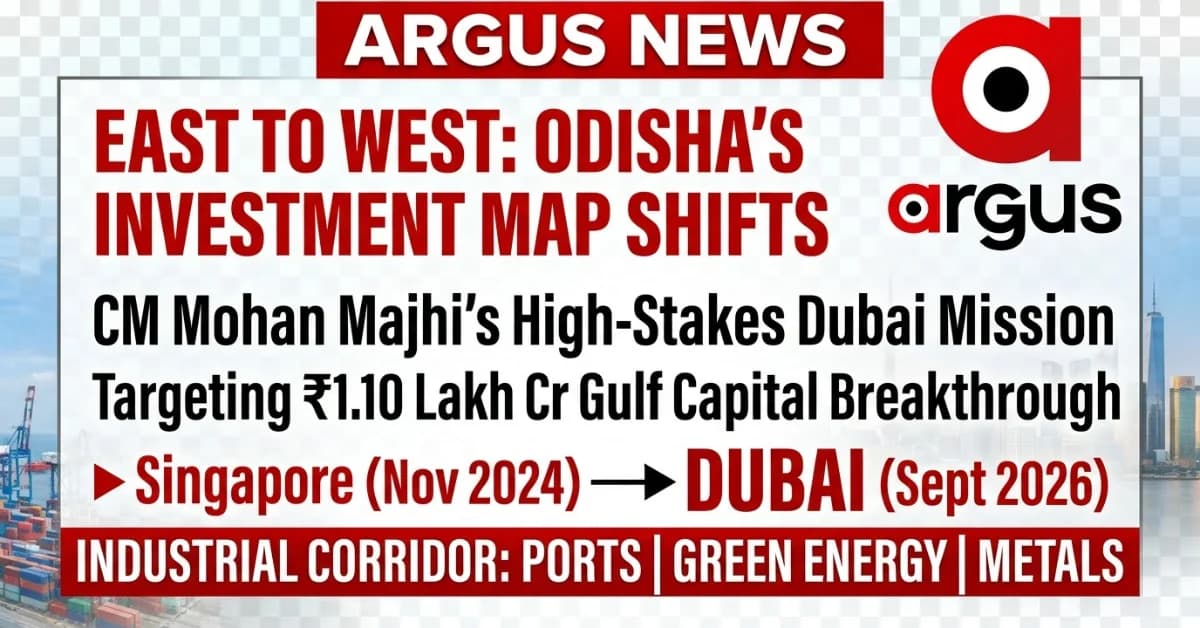
Majhi’s upcoming Dubai visit on September 8-9, 2026, marks his second foreign trip as Chief Minister, following his maiden investment-focused Singapore tour in November 2024.
The timing is significant: between the two overseas investment pushes, Odisha hosted the mega Utkarsh Odisha–Make in Odisha Conclave 2025 and secured investment proposals worth Rs16.73 lakh crore across 593 projects.
Now, the UAE is emerging as a particularly important target market after Abu Dhabi-based International Holding Company (IHC Group) entered into a massive $11.5-billion, or around Rs1.10 lakh crore, joint venture with the Adani Group for an integrated aluminium project in Odisha.

📱 Get Argus News App
✨What Odisha Can Offer Dubai?
For UAE investors, Odisha’s pitch is not simply about incentives – it is about plugging into a ready industrial ecosystem built around resources, energy and maritime connectivity.
The State offers deep-water ports such as Paradip, Dhamra and Gopalpur, government-backed industrial land and a single-window investment framework, creating a potential gateway for UAE capital into eastern and southeastern Asian markets.
The opportunity extends well beyond Odisha’s traditional steel and aluminium economy.
The State is now pitching chemicals and petrochemicals around Paradip, green hydrogen and green ammonia, large renewable-energy projects, multimodal logistics and warehousing, food and seafood processing, textiles, IT, electronics and semiconductor-linked manufacturing.
For UAE sovereign funds and corporates, this creates several entry points – from green-energy investments and maritime logistics to food-security supply chains and downstream manufacturing.
The underlying proposition is particularly relevant to Gulf capital: invest in Odisha’s resource base, manufacture at scale and use its eastern coastline to access Asian markets.
The recent IHC-Adani investment could therefore become more than a standalone aluminium project; it could serve as a signal to other UAE investors that Odisha is capable of hosting very large, asset-backed investments. The project is already moving through statutory approvals and land-allocation processes.
Maharashtra, Gujarat, Tamil Nadu Have The Suits; What Odisha Has?
The bigger question is whether Odisha can actually attract UAE capital when Maharashtra, Gujarat, Karnataka, Tamil Nadu and other established investment destinations are also competing aggressively for Gulf money.
The answer may lie in choosing the right investment battle.
Odisha cannot realistically outcompete Mumbai or Bengaluru in financial services, consumer internet or mature startup ecosystems.
But in heavy manufacturing, metals, clean-energy-intensive industries and integrated logistics, its proposition is substantially different.
Odisha's biggest advantage is the combination of mineral resources, industrial land, power availability and an eastern maritime location.
The State has significant bauxite and iron-ore reserves and can offer captive mineral linkages to resource-intensive industries.
It also has large government-banked industrial land parcels through IPICOL, while its deep-draft ports provide direct access to the Bay of Bengal and Asian supply chains.
That gives Odisha a niche that competitors cannot easily replicate.
Maharashtra and Gujarat have superior western-coast connectivity to the UAE and Europe, while Tamil Nadu has a powerful manufacturing and automotive ecosystem.
Karnataka and Maharashtra remain far stronger in technology, finance and startups.
But for a UAE investor seeking to deploy billions into physical assets – metals, chemicals, ports, logistics, renewable energy and large manufacturing plants – Odisha offers a combination of land, raw materials, power and coastline that can make project economics attractive.
From A ₹21,800-Crore Beginning To A ₹1.10-Lakh-Crore Breakthrough
The UAE-Odisha investment relationship is not beginning with Majhi’s 2026 Dubai visit.
Its first major breakthrough came in June 2022, when an Odisha government-led investors’ meet in Dubai generated MoUs and expressions of interest worth $2.76 billion, or around Rs 21,800 crore. Among the early commitments was Lulu Group International’s Rs1,500-crore proposal covering hypermarkets, malls and agri-seafood sourcing hubs in Bhubaneswar, Cuttack and Rourkela. Though, the investment intention has not been implemented on the ground as of now.
However, the scale of the relationship has now changed dramatically, when the $11.5-billion IHC-Adani joint venture tied to a proposed 4-million-tonne-per-annum alumina refinery and smelter complex.
The larger opportunity is also linked to the UAE’s position as a major investor in India.
UAE investments in India have exceeded $25 billion, with sovereign wealth funds such as ADIA and Mubadala and major UAE corporates playing an important role.
Yet UAE and global FDI remains highly concentrated in a handful of Indian states, with Maharashtra, Karnataka, Delhi and Gujarat occupying the top tier and Tamil Nadu, Telangana, Andhra Pradesh and Haryana forming another important cluster.
Odisha has historically remained outside the top 10 for non-commodity FDI equity inflows.
That is precisely why the Dubai visit matters. Odisha does not need to become another Mumbai or Bengaluru to win UAE capital. It needs to convince Gulf investors that the State can become India’s eastern industrial and logistics base for long-term, large-ticket capital.
The Dubai Factor: Odisha Diaspora Could Become The Investment Bridge
There is another, less visible economic asset behind the Chief Minister’s Dubai visit – the Odia diaspora.
The UAE is home to a large Indian expatriate population, while estimates put the Odia community across the UAE at more than 15,000-20,000, with over 10,000 residing in Dubai.
The community spans construction and port workers as well as professionals in aviation, banking, IT and engineering, and is organised through cultural groups such as Odisha Samaj UAE.
For Odisha, this diaspora can potentially function as more than a cultural constituency. It can be an informal business network connecting the State with UAE-based entrepreneurs, professionals, investors and corporate decision-makers.
The delegation is also expected to engage with the diaspora around the long-pending demand for a direct Bhubaneswar-Dubai air connection – an issue that has implications not only for passenger movement but also for tourism, business travel, trade and investment flows.
Majhi’s
first foreign investment tour took Odisha east to Singapore. His
second is taking the State west to Dubai. The geography has changed,
but the investment strategy is becoming clearer: use
Odisha’s resource strength, ports, land and industrial ecosystem to
attract global capital.
The
real test of the UAE visit, however, will not be the number of MoUs
signed in Dubai.
It will be whether the IHC breakthrough can be
converted into a wider pipeline of UAE capital across green energy,
logistics, food security, petrochemicals, textiles, technology and
downstream manufacturing, and turn Odisha from an occasional
investment destination into a sustained Gulf-capital magnet.
Related Topics
Explore more stories