



India vs South Africa / From Dew to Drama: How the T20I at Barabati Panned Out
Key Points
- Hardik Pandya’s all-round brilliance powered India to a dominant win at Barabati.
- South Africa collapsed to their lowest-ever T20I total of 74, losing last 5 wickets for 6 runs.
- Records tumbled as Bumrah claimed his 100th T20I wicket and Hardik smashed his 100th six.
Cuttack, Dec 10: The curtain raiser of the five-match T20I series between India and South Africa delivered a surprising result at Cuttack’s iconic Barabati Stadium, Tuesday. It was unexpected, to be exact.
The hype around the match was such that everyone — whoever looked at the pitch from close, especially the curator and former players — had predicted a high-scoring encounter. The match was predicted to register the highest T20I total at the venue, surpassing the India’s 180/3 against Sri Lanka in 2017.

📱 Get Argus News App
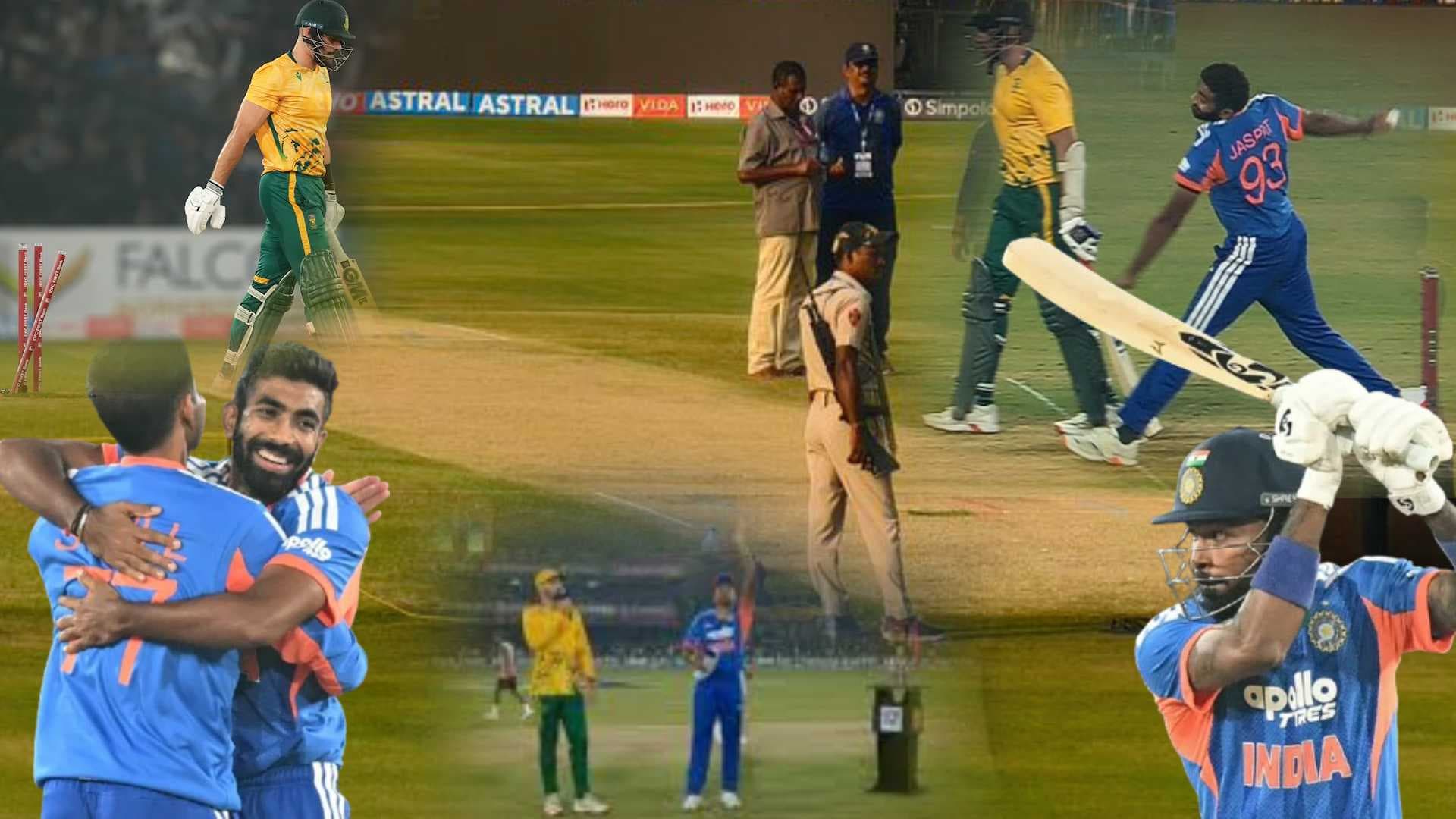
✨But, how the match panned out: India somehow posted 175/6, thanks to a batting masterclass from Hardik Pandya — unbeaten 59 off 28 balls laced with six 4s and four 6s. In response, the Proteas were outclassed, outplayed and humbled — being bundled out for a paltry 74 in just 12.3 overs.
However, it doesn’t tell the whole story. Let’s dissect the match categorically.
Dew Influenced Toss
Dew plays a crucial role in matches played during the winter, sometime influencing the toss with teams going against the pitch condition. The Barabati T20 witnessed something similar, not entirely though.
South Africa skipper Aiden Markram called it right at the
toss and opted to field, and the reasons — dew, which played a major role in
the recently concluded ODI series, and the look of the pitch which suggested
early help for pacers.
Also read: Hardik Pandya Reveals His “Biggest USP” after Masterclass at Barabati Stadium
Pitch Played Bluff
Every now and then, we’ve seen pitches behave quite differently from how their appearance initially suggested. And the Barabati wicket did exactly that. At the pitch report, Deep Dasgupta and Pommie Mbangwa suggested that the surface looked hard and should play better than it looks offering runs for batters.
The red soil was covered with grass, hiding cracks beneath, and with dew factor, high-scoring contest was expected. But how the pitch played — a sticky surface with some tennis ball bounce, and just like what Hardik Pandya said after the match: “The wicket had a bit of spice.”
The nature of the surface was on display from the very first ball, especially the deliveries which dismissed Shubman Gill and Indian skipper Suryakumar Yadav — both the batters went for big shots, failed to time it with the ball not reaching their bats courtesy the slowness of the pitch getting leading edges that ballooned straight up for simple catches for South Africans.
Team Combination
The team combination plays a massive part in any format of the game, especially in the T20s, considering the teams had to balance their batting and bowling options having enough varieties to outmanoeuvre the opposition. All the Indian batters, other than Hardik, were a bit disappointing, the bowlers did fantastic job though, with each of them having wickets to their names.
South Africa, on the other hand, opted for a pace-dominated bowling unit featuring Marco Jansen, Lungi Ngidi, Anrich Nortje, and Lutho Sipamla, with Keshav Maharaj as their lone specialist spinner. Experts questioned the omission of all-rounder Corbin Bosch, who impressed in the ODIs. Including him could have strengthened the batting depth while also adding balance to the bowling attack. The Proteas would definitely consider the thought of including him in the second T20I in New Chandigarh.
Adapting to Pitch & Condition
In cricket, whether batting or bowling, adapting to pitch and venue conditions — like the outfield or weather — is a must. The South African bowlers managed this well until Hardik Pandya came roaring. Watching the match, it almost felt as if he was playing on a different surface than the rest. His edge lay in quickly reading the conditions, adjusting to the pitch, and then unleashing his natural game — a commanding display of power-hitting.
South Africa batters, on the other hand, were looked clueless. They struggled to find the rhythm or any sort of momentum. None of the batters even tried to go old school — take some time, watch the ball, judge the surface and then up the ante. And Indian bowlers were dominating with their line and length. Even when they were hit for a boundary or a six, they adjusted and got rewards. It was like the England’s Bazball approach in all kinds of surface, which has widely been criticised.
Hardik Saves the Day
The all-rounder returned to the side after an injury layoff. He had been sidelined since the Asia Cup in September and missed the Australia tour due to a quadricep injury. He trained alone at the Barabati Stadium on December 7, knowing he had to work harder than the rest as he was out of action for more than a couple of months. And it paid off massively.
Hardik walked off to the middle when India were struggling at 78/4 in the 12th over. The score prediction, at that time, was around 150. However, his experience and well-calculated shot selection put India in a strong position — 175/6. Not just with the willow, but with the cherry as well. He dismissed David Miller on his very first delivery, aided by sharp work from Jitesh Sharma behind the stumps. It would be interesting to see how he performs in the rest of the matches with the 2026 T20 World Cup approaching.
Proteas Looked Hapless
Chasing down a target of 176 in a T20I is not that challenging, only if the surface and opposition let you do so. And on Tuesday, neither the Barabati pitch, nor the Indian bowlers allowed the visitors to do something what they did in the second ODI in Raipur — a sensational 359-run chase.
Arshdeep Singh extracted enough swing to get rid of Quinton de Kock in the very first over, before dismissing Tristan Stubbs in his next over, thanks to his swing and some purchase off the pitch. His bowling partners also continued in the same vein bowling the Proteas out for 74 — their lowest total in T20Is. Such was the Indian bowlers’ domination that South Africa shockingly lost their final five wickets for only six runs.
No-Ball Controversy
The Men in Blue delivered a brilliant performance with Hardik Pandya at the forefront, but the celebration was jolted by a surprising and contentious decision from third umpire (TV umpire) KN Ananthapadmanabhan that left many raising eyebrows. It was the dismissal of Dewald Brevis.
Brevis, going for a big shot off a sharp back of a length ball on off stump, was late on the pull and spooned it straight up with Suryakumar Yadav at extra cover comfortably held onto the catch. Everything was fine, until a soft voice echoed on the TV screen — “Stand by… checking for a possible no-ball.” It was Ananthapadmanabhan on the audio. Just a few seconds later, another audio was heard — “It's a fair delivery.” Brevis was back in the hut. However, the visuals, soon after Brevis’ return to dressing room, raised many eyebrows.
There were two angles of the visual — one from cover region and another was from stump camera. Both the visuals in a way were suggesting it was a no-ball. However, going by the rules, the visuals weren’t conclusive to overturn the ‘Out’ call. The decision was caused mainly due to the obstruction of exact camera angles from either side of the crease line — one by the runner and the other by an Indian fielder —, which made it difficult for the TV umpire to check the exact position of the bowler’s foot. What do you think — was that out or not out?
Amidst all the drama, the bowler — Jasprit Bumrah — definitely enjoyed every bit of it, especially after the decision went his way. And why not, it was his 100th scalp in T20Is.
Records Tumble
The match had everything — from miss-hits to celebrations. In between, there were milestones and an unwanted record. Hardik Pandya achieved the first milestone of the day, hitting his 100th six in the T20Is — 4th Indian to do so, before Jasprit Bumrah claimed his 100th T20I wicket dismissing Dewald Brevis. He is the second Indian to achieve the feat after Arshdeep Singh.
South Africa, on the other hand, had to settle with an unwanted record registering their lowest total in T20Is — 74 — lower than their previous lowest of 87 all out, also against India, in 2022 in Rajkot.
The win was India’s ninth with a victory margin of over 100 runs in T20Is — most by a full member team and second overall behind Canada (10).
What’s Next?
Heading into New Chandigarh, Team India’s confidence will be
soaring. With the T20 World Cup approaching, the management’s priority will be
striking the right balance. So we can expect a few tinkering in the playing XI,
not just from India, but for South Africa as well.
Related Topics
Explore more stories